
Introduction
A carrier-up indicator is weak evidence in a Dubai Internet City data centre. A 10G link can stay up while a dirty LC pair, a poor splice, or heat around a dense line card has consumed most of its margin. The symptom often arrives later as CRC errors, bursts of packet loss, or an optic that appears to fail only at busy times.
Treat fibre acceptance and fault isolation as separate jobs. An optical loss test set (OLTS) establishes end-to-end loss. An OTDR maps events and distance. A microscope exposes contaminated end faces. DOM telemetry connects those measurements to a live service. This order matters in an Abu Dhabi SCADA backhaul as much as it does in a data-centre row: it produces evidence before anyone swaps hardware.
Teams planning a move from 10G to 25G should also review data-centre high-speed migration. Faster optics do not forgive a weak channel; they expose it.
Technical operating principles and loss budgets
Use 850 nm testing for the relevant OM3 or OM4 multimode service, and 1310/1550 nm for OS2 single-mode routes. Short OTDR pulses resolve closely spaced events in an equipment room. Longer pulses provide dynamic range on a multi-kilometre route, but their larger dead zones can hide a nearby connector. Launch and receive leads place the first and last mated pairs outside those zones, so both connections appear in the record.
The design calculation is simple:
$P_{\text{budget}} = P_{\text{Tx_min}} - S_{\text{Rx_sens}}$
For a representative 10G LR interface, $P_{\text{Tx_min}}=-8.2\text{ dBm}$ and $S_{\text{Rx_sens}}=-14.4\text{ dBm}$ give a 6.2 dB minimum budget. If bidirectional OLTS tests show 2.0 dB installed loss, retain at least 3 dB for ageing, repairs, temperature and component tolerance. That leaves 1.2 dB, which is not permission to add an undocumented cross-connect.
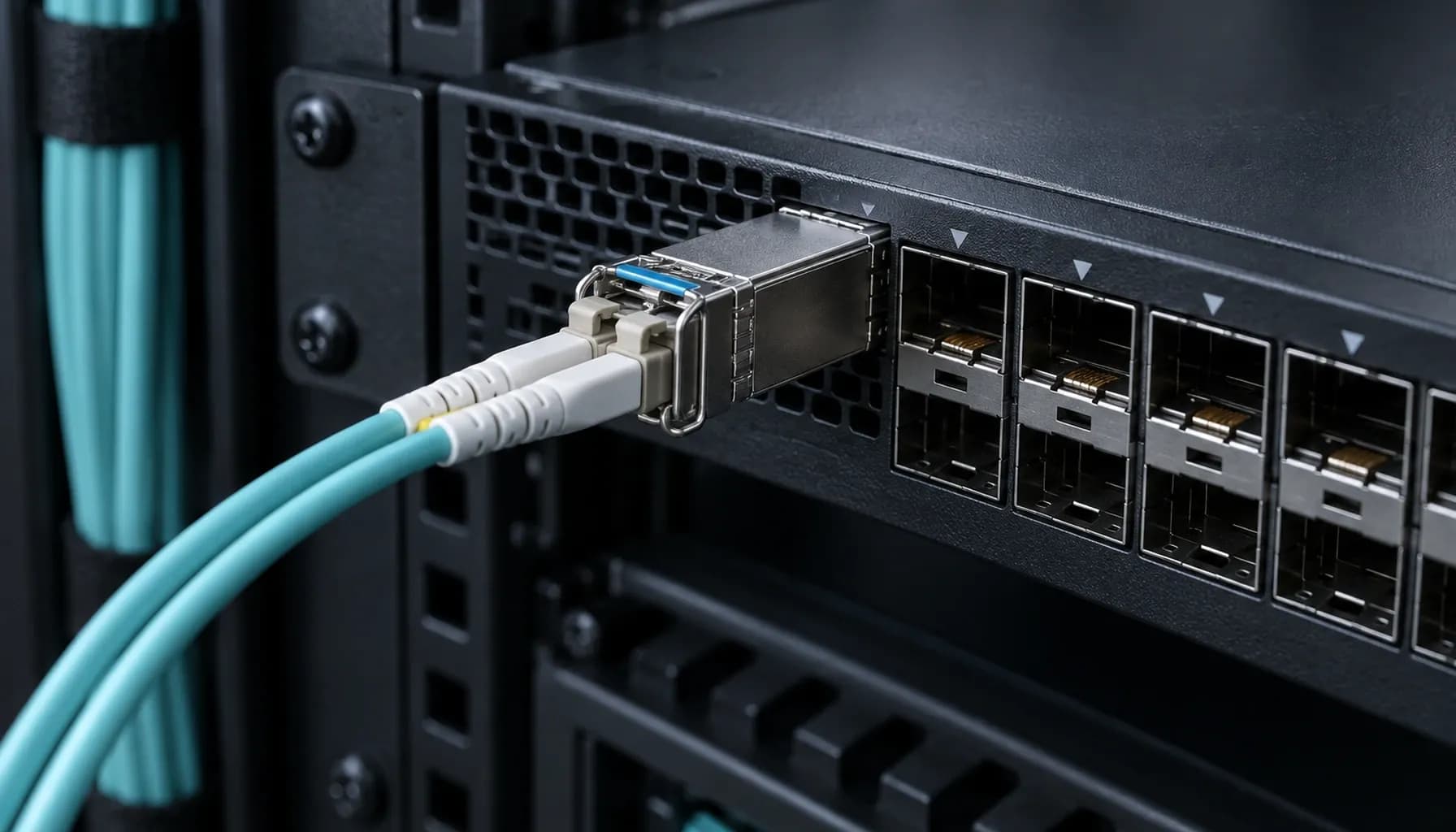
SFF-8472 DOM/DDM reports temperature, voltage, laser bias, transmit power and received power. Use it to correlate a live fault, never as the acceptance test. Compare its readings with a clean baseline and a calibrated power meter. Once the channel is proven clean, an exact-coded Strinex Alpha Bridge ASFP-10G-SR provides a sensible replacement route for short-reach 10G links.
Comparison matrix
| Parameter | Strinex Alpha Bridge | FS.com Equivalent | Cisco OEM | Generic / Refurbished |
|---|---|---|---|---|
| Trace and DOM workflow | Confirm exact module data sheet, host code and DOM support before dispatch | Confirm the selected compatible SKU and its diagnostics | Use the platform-qualified PID and supported diagnostics | Verify whether DOM is present, calibrated and readable |
| Coding and interoperability evidence | Match host coding to Cisco, Juniper, Arista or MikroTik before fitting | Confirm coding service and order details | Native qualification for the stated platform | EEPROM identity and alarm behaviour can vary |
| Optical specification | Choose SR/LR, wavelength and fibre class from the measured channel | Match the precise optic rather than the family name | Match the PID to the port and circuit design | Check label, wavelength, connector and data sheet |
| UAE stock and support | Dubai stock and local technical support when available | Fulfilment depends on the order route | Channel availability and contract terms vary | Stock provenance is often unclear |
| Warranty and documentation | Regional warranty path and product documentation | Seller terms and documentation apply | OEM support contract and entitlement apply | Obtain written warranty and test evidence |
A transceiver label does not certify a channel. Buy the optic after the loss result, host policy and connector condition agree. That discipline costs less than a second site visit.
Interoperability and host validation
The host port decides whether a compatible optic is usable. Cisco Catalyst and Nexus, Juniper EX and QFX, Arista 7050-series platforms, and MikroTik devices can each enforce different EEPROM, speed, alarm and FEC policies. SFF-8431 covers the SFP+ electrical interface; SFF-8472 describes diagnostic memory and calibration conventions. Valid light at the connector does not override a rejected host code.
Validate both ends of the circuit. Low receive power at one end points to direction-specific loss; absent transmit power may indicate a disabled port or failed emitter. Healthy power with CRC or FEC errors shifts attention to the host lane, encoding or configuration. Read SFF-8472 DOM/DDM diagnostics before interpreting thresholds. The warning limits in that module's data sheet, not a generic dBm rule, govern the decision.
Field deployment and maintenance
Keep the field bend radius above $30\text{ mm}$ unless the cable manufacturer requires more. Tight turns at cabinet doors and unsupported patch-cord weight create losses that are annoyingly intermittent. Test at the operating wavelength, record the reference method, and capture bidirectional OLTS results before service handover. Archive OTDR .sor traces with the route, port identifiers, launch and receive cords, tester calibration state and date.
Use IEC 61300-3-35 discipline at every reconnection: inspect, dry-clean, inspect again, then mate. A clean-looking ferrule can still carry oil film or debris outside the naked eye's view. If an OTDR shows a reflective event, inspect the connector pair before scheduling civil work. Reflections commonly mean an air gap, damaged end face or poor connection rather than normal distributed attenuation.
Recommended diagnostic utilities and testing tools
Use a scope before cleaning, an OLTS for acceptance, and an OTDR to locate the exception. The following tools cover that sequence:
- Fluke Networks CertiFiber Pro measures bidirectional insertion loss and length for the handover record.
- EXFO MaxTester 720C OTDR locates loss events, reflections and breaks across enterprise and outside-plant routes.
- VIAVI SmartOTDR gives field teams portable OTDR analysis for fibre characterization and restoration work.
Frequently asked questions
What does an OTDR detect that an optical power meter cannot?
An OTDR locates events along a fibre and estimates their distance, reflectance and attenuation behaviour. A power meter measures end-to-end received power but cannot identify the failing splice or connector. Use the power-meter/OLTS result for channel loss and the OTDR trace to explain the route.
How much loss margin should a UAE enterprise fibre link retain?
Retain at least 3 dB after measured installed loss, documented connector and splice allowances. The exact figure still depends on the optic data sheet, service design and repair exposure. Hot cabinets and later changes make a thin margin expensive.
Can DOM/DDM replace an OTDR test?
No. DOM/DDM reports what the module sees at that moment and may use internally calibrated values. It cannot map a route or certify end-to-end insertion loss. Correlate DOM with OLTS baselines and OTDR traces.
Why can a clean-looking LC connector still create high loss?
Fine debris, oil film, microscopic scratches and a poor physical contact can be invisible without inspection. Cleaning blindly can grind contamination into the end face. Inspect, dry-clean and inspect again before mating.
Should Cisco, Juniper, Arista and MikroTik links be tested differently?
The optical measurement method remains the same, but host validation does not. Check each platform's coding policy, supported speed, diagnostics, alarms and FEC behaviour. Keep the same evidence set at both ends: interface state, DOM values, error counters and physical baseline.
Key takeaways for UAE network teams
- Design from measured loss and the module budget, then preserve at least 3 dB of engineered margin.
- Pair bidirectional OLTS acceptance results with OTDR event traces; neither test replaces the other.
- Keep fibre bends above 30 mm and follow IEC 61300-3-35 inspect-clean-inspect practice for every ferrule.
- Validate host coding, DOM thresholds and error counters across Cisco, Juniper, Arista and MikroTik before condemning an optic.
- Prefer documented Dubai stock, regional warranty and a traceable replacement path for urgent restoration work.
Conclusion and local UAE procurement
A dependable fibre service has matching loss records, event traces and live telemetry. Establish that baseline at handover, control changes, and inspect the physical layer before replacing switches or optics. For a measured and validated short-reach 10G replacement, order the Strinex Alpha Bridge ASFP-10G-SR from local Dubai stock where available, with regional warranty and same-day dispatch for ex-stock orders.