
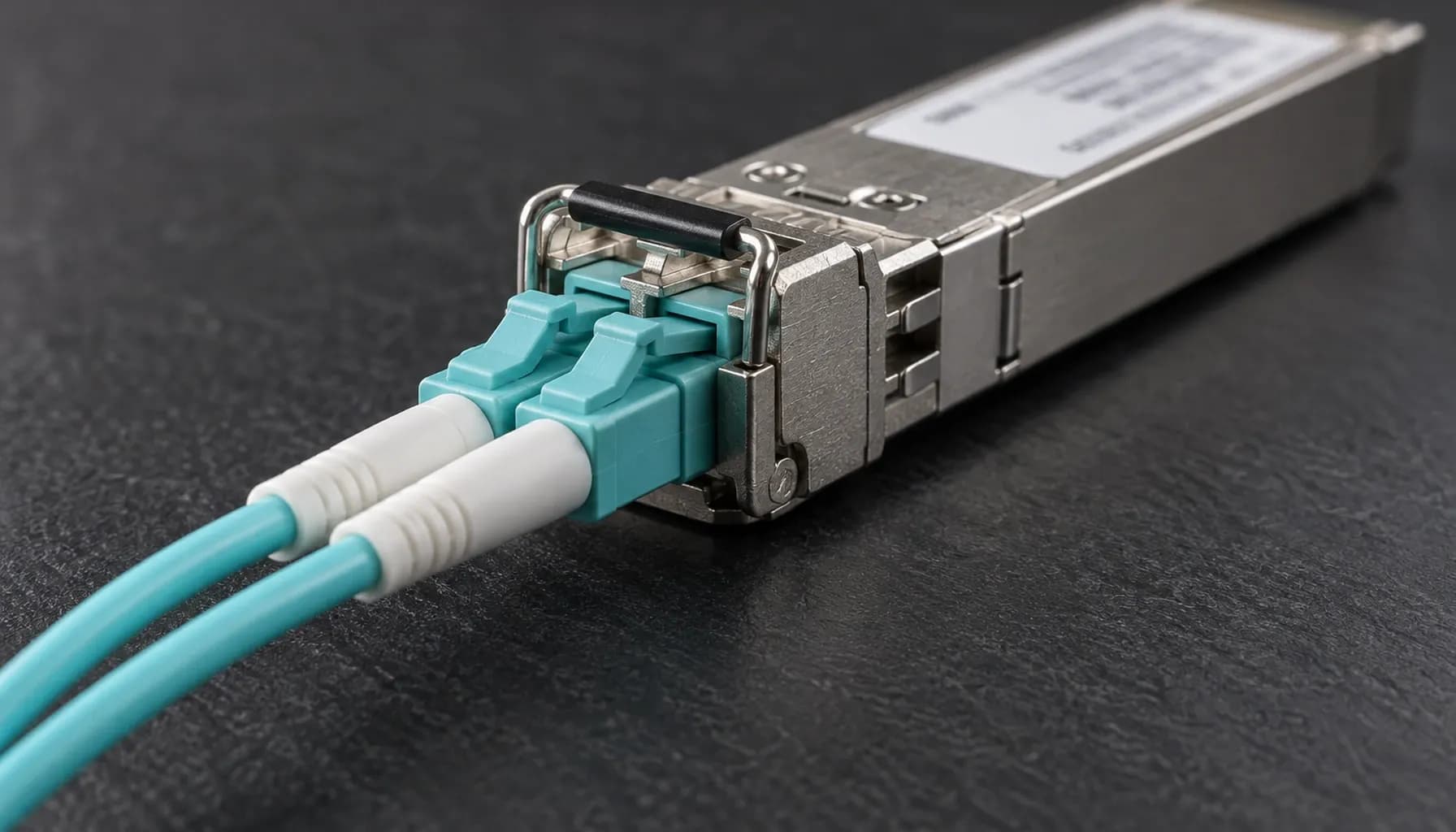
The 2026 End-of-Sale Engineering Problem
“100G end-of-sale” is a SKU-specific supply-chain event, not the retirement of 100G Ethernet. A QSFP28 optic, switch line card and software train can have different final-order, RMA and support dates. Because 100G demand remains active for AI, edge and fabric uplinks, the 2026 risk is constrained last-time-buy supply and unsupported revisions—not bandwidth obsolescence. For UAE buyers, “Last Ship Date” can mean final order acceptance rather than delivery, so every notice must be read SKU by SKU.
Qualify the Architecture Before Buying the Last Ship
A 100G path is a negotiated system: switch ASIC and line card, cage and connector, module firmware, fiber, FEC/duplex settings, and transceiver-monitoring policy. Mechanical QSFP28 compatibility proves only form-factor fit.
| Qualification point | Cisco Catalyst 9300/9400 and Nexus 9300 | Arista 7050X | Juniper QFX5120/5200 | Procurement test |
|---|---|---|---|---|
| Host path | QSFP28; breakout is ASIC- and port-specific | QSFP28; breakout depends on platform and EOS release | QSFP28; breakout depends on QFX port and Junos release | Require an exact host–port–module matrix |
| Software | IOS-XE or NX-OS support train | EOS release and feature set | Junos release and feature set | Pin a tested image, not only a model family |
| Optics and standards | IEEE 802.3 100G PHYs; SR4/DR1/FR1/LR1/ER4 support by SKU; DOM varies | IEEE 802.3 PHYs; EOS-qualified media and reach; DOM depends on module | IEEE 802.3 PHYs; Junos-qualified media and reach; DOM depends on module | Match PHY, fiber, reach and DOM thresholds |
| Link metrics | CRC, FEC and physical counters vary by software train | Interface, CRC and FEC counters vary by EOS release | Interface, CRC and FEC counters vary by Junos release | Capture timestamped deltas, not inherited totals |
| Lifecycle | Product notices and supported replacements | EOS/product notices and qualified optics lists | Product-support notices and supported replacements | Record LTB, LSD, RMA and software dates separately |
SR4 uses four lanes; DR1, FR1 and LR1 are single-lane designs; ER4 uses four wavelengths. Accepting 100G does not guarantee 4×25G breakout, and a breakout DAC is not a certified breakout optic. Temperature grade remains a separate qualification, and standards compliance alone does not establish the optical power budget.
Key takeaway: Qualification is a platform-and-SKU decision; “100G” or “QSFP28” alone is not a compatibility statement.
Decode the Lifecycle Clock
Before a last-time buy, obtain the exact order deadline, final shipment date, RMA cutoff, software and security-support date, last firmware and replacement path. Confirm that the notice applies through the UAE distributor and channel. Last Ship Date may close ordering while hardware remains repairable, or software support may end before inventory is exhausted.
Freeze the bill of materials by manufacturer, part number, revision and firmware. Map each item to an approved replacement and qualification test. Reserve production, expansion and 1:1 spares separately; an unsupported spare is not resilience. Require serialized, sealed stock, traceability and written warranty terms. Never infer a lifecycle date from a family name or marketplace listing.
Key takeaway: Last Ship Date controls supply; it does not define warranty, software security or RMA coverage.
Multi-Vendor Compatibility and Diagnostic CLI
Use each platform’s native counters and DOM commands, then normalize the evidence. Command syntax and counter names vary by release, so treat this read-only block as a template rather than paste it blindly.
1# Cisco Catalyst 9300/9400 — IOS-XE2show version3show interfaces hundredGigE 1/0/1 transceiver details4show interfaces hundredGigE 1/0/1 counters errors5show running-config interface hundredGigE 1/0/16
7# Cisco Nexus 9300 — NX-OS8show version9show interface ethernet 1/1 transceiver details10show interface ethernet 1/1 counters errors11show running-config interface ethernet 1/112
13# Arista 7050X — EOS14show version15show interfaces Ethernet1 counters errors16show interfaces transceiver17show running-config interface Ethernet118
19# Juniper QFX — Junos20show version21show interfaces et-0/0/0 extensive22show interfaces transceiver23show configuration interfaces et-0/0/0
Collect identical timestamps, link state, negotiated speed/FEC and counter deltas. An inherited total proves little; capture the change across a controlled interval and after each single-variable substitution. Preserve the original baseline because a factory reset can erase the evidence needed for escalation.
Routine Failure Analysis
Establish a controlled baseline
Record module identity, switch port, negotiated FEC, ambient temperature, airflow and all available DOM fields before testing. Compare Rx/Tx power, bias, temperature and lane values with the module specification, not generic limits. For Gulf deployments, verify the marked grade and thermal margin; Choosing a Temperature Grade for Gulf Deployments: C-Temp, E-Temp and I-Temp Compared for 100G (2026) explains the C-, E- and I-Temp decision. Execute Pre-Ship Optics Acceptance for 100G Ports: Module-Type, DOM Threshold and Reach Checks (2026) before installation and retain the result with the serial number.
Separate optical, fiber and switch faults
Use this fault-isolation sequence:
- No light or no link: Check cage seating, port administration, module recognition, Tx output, fiber type, polarity and the peer’s FEC/speed mode.
- Rising errors with healthy DOM: Inspect connectors and adapters under magnification for contamination, scratches and strain. Replace one qualified cord or optic at a time.
- One parallel lane failing: Correlate lane telemetry and the mating port where available; aggregate counters alone do not prove an ASIC failure.
- Errors following one module or cord: Use controlled substitutions to isolate the component. Errors persisting across modules on one port point toward the port, line card or ASIC path.
- FEC-corrected errors: Treat these as a marginal channel requiring remediation. Repeated uncorrectable FEC or invalid CRC is service-impacting.
Do not collapse “stomped CRC,” invalid CRC, symbol errors and physical-layer errors into one label; they do not identify the same fault domain. Stomped CRC vs Invalid CRC on 100G Ports: Separating Switch ASIC Faults from Cable and Connector Faults (2026) explains how to separate ASIC indications from connector, cable and optics evidence.
Make the case RMA-ready
Bundle the exact part and serial number, firmware, symptom, timestamped DOM and counter deltas, switch/software details, line-card and port mapping, fiber type and length, connector inspection, and substitution results. Preserve the failed optic and cord. Include ambient temperature and airflow because thermal exclusions are disputed. Escalate with the vendor’s serial-number log, not only a “link down” statement.
Key takeaway: A controlled baseline and one-variable substitution test produce better RMA outcomes than repeated blind swaps.
Data Center High-Speed Migration (10G → 25G → 100G): UAE Cost and Procurement
For UAE data center high-speed migration (10G → 25G → 100G) cost analysis and procurement, separate link demand from switch architecture. A certified 4×25G breakout may reduce port count and cable runs, but it does not reduce optical count to one. Compare native 25G against 100G breakout on module price, peer compatibility, platform support, power, rack density, installation labor and failure-domain size.
Build landed TCO, not spreadsheet unit price: optics, ports and ASIC upgrades, fiber and adapters, structured cabling, installation, configuration, support, spares, freight, customs, VAT, channel margin and the cost of an EOL SKU becoming unserviceable. Add qualification labor and a replacement reserve based on measured failure rate and supplier lead time—not a generic spare percentage. For 10G-to-25G sites, document why a 100G host is selected rather than simply extrapolating bandwidth. In UAE facilities, include dust inspection, connector-cleaning controls and the correct thermal grade in operating cost. Do not substitute an unqualified low-cost optic for a qualified lifecycle plan.
Frequently Asked Questions
Does the 2026 end-of-sale apply to every 100G module?
No. It applies only to exact SKUs, hardware revisions, software trains or switch platforms named in each notice. Active IEEE 100GBASE products can remain supported through other suppliers. Request the SKU-level notice, including UAE channel coverage and exact last ship date; never treat “100G” as one lifecycle.
What is the difference between Last Ship Date and end of support?
Last Ship Date is generally when a vendor stops accepting or fulfilling orders for the identified SKU. Support is separate and may cover software, documentation, vulnerability fixes and RMA processing. A module can remain sellable while its platform loses a software train. Obtain written dates for each service and a tested migration path before the last-time buy.
Can one 100G QSFP28 port carry four 25G links?
Only when the switch ASIC, port, software release, module and configured mode all support breakout. QSFP28 does not guarantee 4×25G, and not every SR4, DR1, FR1, LR1 or ER4 module supports it. Confirm the exact line-card/module matrix, use the required optic, match peer optics and FEC, then test all four lanes.
What evidence should be attached to a 100G module RMA?
Attach part and serial number, firmware, symptom, timestamped counters and DOM readings, switch/software, line card/port mapping, fiber type/length, connector condition and substitution results. Preserve the original module and cord. Include ambient temperature and airflow because thermal exclusions are disputed. Keep the RMA deadline and serial logs with the case.
Should a UAE buyer place a large last-time-buy order?
Not automatically. Size the buy against workload growth, approved substitutes, obsolescence exposure and the cost of carrying a SKU whose firmware or switch train ends support. Secure written lifecycle dates, traceability and warranty terms, then stage delivery before Last Ship Date while leaving testing and replacement time. In Gulf sites, budget for the correct temperature grade, spares and connector inspection.
Key Takeaways
- Freeze the exact transceiver, revision, firmware, switch and port matrix.
- Record order, shipment, RMA, software and security dates separately.
- Qualify optics, breakout mode, FEC, DOM and thermal grade on target releases.
- Capture controlled failure evidence before, during and after substitution tests.
- Compare native 25G and 100G using landed TCO and obsolescence risk.
Conclusion
For current 100G availability, lifecycle qualification and a procurement-ready quote, review the Strinex catalogue.