
Introduction
A DIN-rail switch in a Dubai Internet City data centre is rarely the weak point because it lacks ports. It fails because somebody treated the control-panel enclosure like an air-conditioned rack. Heat soak, conductive dust, a loose 24 VDC feed, and a poorly grounded shield can turn an ordinary access switch into an intermittent fault that steals days from commissioning.
The same pattern appears in Abu Dhabi industrial SCADA networks. The Ethernet design may be sound on paper, but the installed equipment must tolerate its enclosure temperature, power quality, vibration, and electromagnetic environment. Choose a hardened switch by its documented operating envelope and protection features, then prove the complete panel design. A DIN clip alone does not make a switch industrial.
Technical operating principles and specification checks
Start with the electrical and environmental boundary. Confirm the switch's published temperature range at the planned load, its 24/48 VDC input range, surge and reverse-polarity protection, EMC immunity, and the enclosure's actual heat rise. If the panel reaches 68°C in summer, a 60°C commercial device has already failed its selection review.
For fibre uplinks, approve the channel rather than the optic in isolation. The basic calculation is $P_{budget} = P_{Tx_min} - S_{Rx_sens}$. Available budget must cover fibre attenuation, connector and splice loss, patching, and a reserve for maintenance. DDM is useful after handover, but its thresholds belong to the fitted module; they are not a universal pass/fail scale. Use the live readings as a baseline and investigate a trend before the link begins dropping frames.
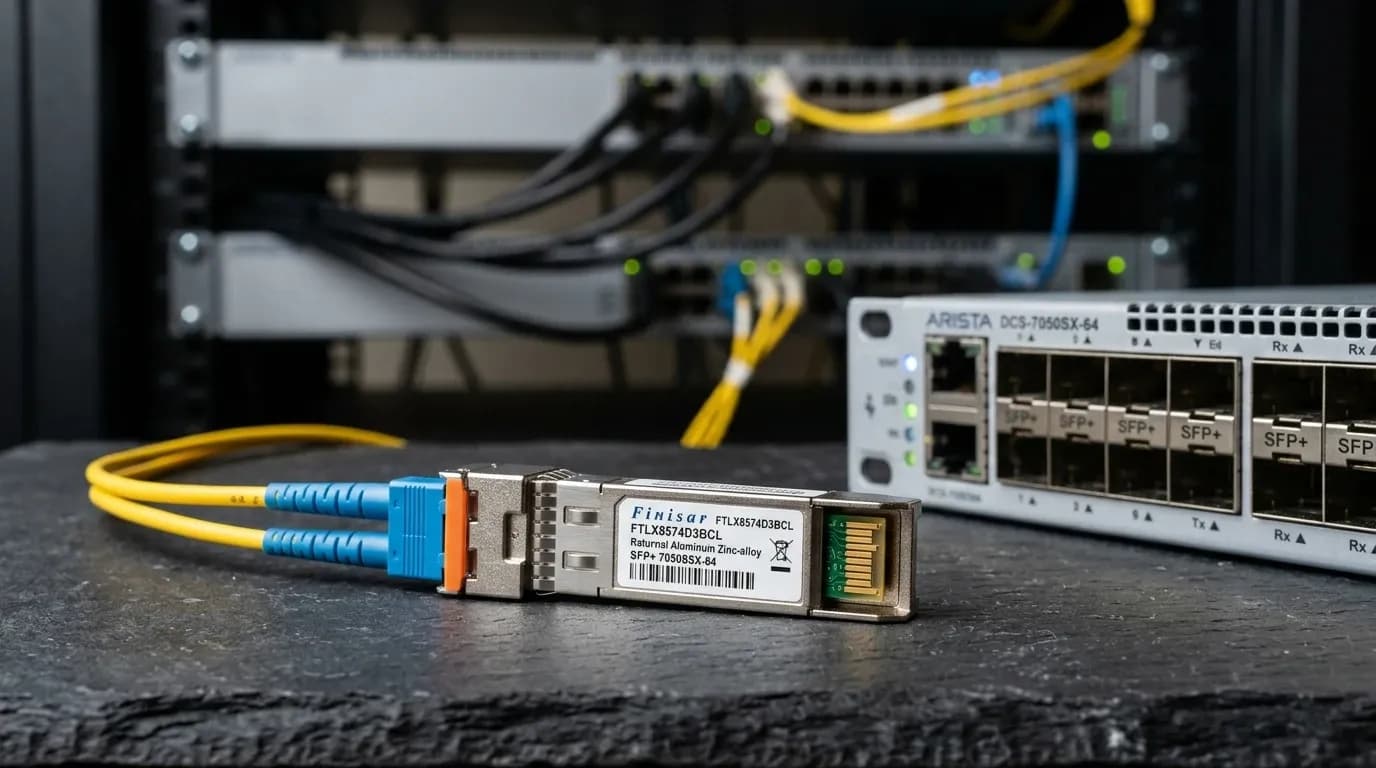
For short multimode monitoring links, the Alpha Bridge ASFP-1G-SX optical transceiver is a relevant 850 nm uplink option. Match its fibre, reach, and host policy to the project. Do not select an optic because the LC connector happens to mate.
Comparison matrix
| Parameter | Strinex Alpha Bridge | FS.com Equivalent | Cisco OEM | Generic / Refurbished |
|---|---|---|---|---|
| Industrial temperature class | Confirm the exact data sheet and panel heat-rise calculation | SKU-specific; validate before release | PID-specific; validate before release | Often unclear; require evidence |
| DC input and protection | Confirm voltage range, redundancy, surge, and polarity protection | SKU-specific | Platform/PID-specific | Verify label and test record |
| EMC and mechanical installation | Confirm IEC test declarations, grounding point, DIN clip, and vibration rating | SKU-specific | PID-specific | Provenance and test evidence vary |
| Fibre uplink policy | Match module, host approval, and measured budget | Coding and host policy matter | Native support matrix applies | Highest compatibility risk |
| UAE support path | Local stock and warranty subject to availability | Confirm import lead time | Confirm authorised local stock | Confirm seller, condition, and return terms |
This is deliberately not a beauty contest. Cisco OEM hardware brings a clear support path where its model fits the site. A lower-cost switch can be the better choice only when its declared limits, validation record, and replacement plan are equally clear.
Interoperability and host validation
Cisco, Juniper, Arista, and MikroTik can all carry the same VLANs and management traffic, but they do not share identical optic policy, alarm presentation, or Ethernet defaults. Validate the exact switch model, software release, copper or fibre port mode, VLAN tagging, STP role, LLDP behavior, and multicast settings in a small acceptance rack before the field crew installs anything.
For optical diagnostics, use the SFF-8472 DOM/DDM field guide to capture Tx/Rx power, temperature, voltage, bias, flags, part number, and serial number at both ends. A link-up LED only confirms a moment in time. It does not prove a compatible EEPROM, adequate margin, or a resilient trunk.
Keep one approved spare configuration per switch family. That means the same switch software baseline, exact optic, fibre type, and known-good configuration. It is cheaper than diagnosing a mixed estate during an outage.
Field deployment and maintenance
Mount the switch where airflow is real, not assumed. Separate heat-producing power supplies from sensitive Ethernet gear, leave service access for terminals and fibre, and bond the panel according to the product documentation. Shielded cable helps only when the bonding scheme is deliberate; a casually terminated screen can create a new noise path.
Keep optical service loops above a $>30\text{ mm}$ bend radius unless the cable maker permits a tighter value. Label each end, preserve duplex polarity, and cap unused connectors. A sharply dressed cable route may look tidy while quietly consuming the last margin in the link budget.
Treat connector cleaning as a procedure, not a gesture. Follow IEC 61300-3-35 practice: inspect, dry-clean, inspect again, then mate. Do not touch the ferrule or blow on it. After a repair, record two-ended DOM values and compare them with the acceptance baseline; use calibrated loss testing when the route includes splices, unexplained attenuation, or a disputed handover.
Recommended diagnostic utilities and testing tools
- Fluke Networks FiberInspector Pro finds contamination and endface damage before a connector is mated.
- Fluke Networks CertiFiber Pro OLTS measures fibre loss and length against the channel requirement.
- EXFO MaxTester OTDR locates bends, splice events, and distance-to-fault on longer routes.
Frequently asked questions
What temperature rating should an industrial DIN-rail switch have?
Choose against the measured enclosure temperature, not the outdoor weather report. Include heat from DC supplies, drives, solar gain, and adjacent equipment. The selected switch must remain within its published operating range at the installed load.
Does an IP rating prove a switch is suitable for a control panel?
No. An IP rating addresses defined ingress conditions, not DC supply tolerance, EMC immunity, vibration, or enclosure heat rise. Review all of those properties with the switch documentation and panel design.
Can Cisco, Juniper, Arista, and MikroTik use the same fibre optic?
Sometimes, but MSA form factor alone is not sufficient. Each host can enforce different EEPROM, software, and support policies. Validate the exact module and release in a test rack, then retain the result with the site records.
Does DDM replace a fibre acceptance test?
No. DDM provides operational telemetry that is excellent for baselines and troubleshooting. An OLTS or calibrated optical power meter validates physical loss against the approved channel budget.
How often should fibre connectors be cleaned?
Inspect before every critical mate or re-mate, then clean only when inspection requires it. Protect disconnected ends with caps and keep cleaning tools in the panel kit. Unnecessary contact is also a contamination risk.
Key takeaways: UAE selection checklist
- Select for the measured panel environment: temperature, DC input, surge exposure, EMC, grounding, and vibration.
- Calculate $P_{budget} = P_{Tx_min} - S_{Rx_sens}$ and keep documented loss and maintenance reserve.
- Validate the exact switch, software release, optic, VLAN behavior, and monitoring before field deployment.
- Maintain bend radius above $>30\text{ mm}$ unless the cable specification says otherwise, and follow IEC 61300-3-35 inspection discipline.
- Keep a validated spare and two-ended diagnostic baseline at every critical site.
Conclusion and local UAE procurement
Hardened DIN-rail switching succeeds when the cabinet, power system, cable plant, and host configuration are reviewed as one operating system. Spend the engineering effort before installation: measure the enclosure, validate interoperability, document the budget, and preserve the commissioning baseline.
For UAE projects, Strinex can check local Dubai stock and same-day dispatch availability for the required product configuration. Review the live Strinex networking catalogue, then provide the panel temperature, DC supply, port count, fibre type, route length, and required host platforms for a precise selection.