
Introduction
A rejected optic at 02:00 is rarely an optical problem. In Dubai Internet City data centres, it is usually a host-policy problem: the switch reads the module EEPROM, finds a vendor name or part number it does not expect, then throws a warning or disables the port. That is why a cheap, unqualified optic becomes expensive during a maintenance window.
Third-party optics are a sound engineering choice when they are built to the relevant MSA and IEEE requirements, coded for the host, and tested in the actual line card. They are not a licence to mix unknown modules into a production fabric. Treat coding, diagnostics and traceability as part of the optic specification, especially on high-density 10G and 25G cards and in Abu Dhabi industrial SCADA networks where a marginal link can stop useful work.
Technical operating principles and power budgets
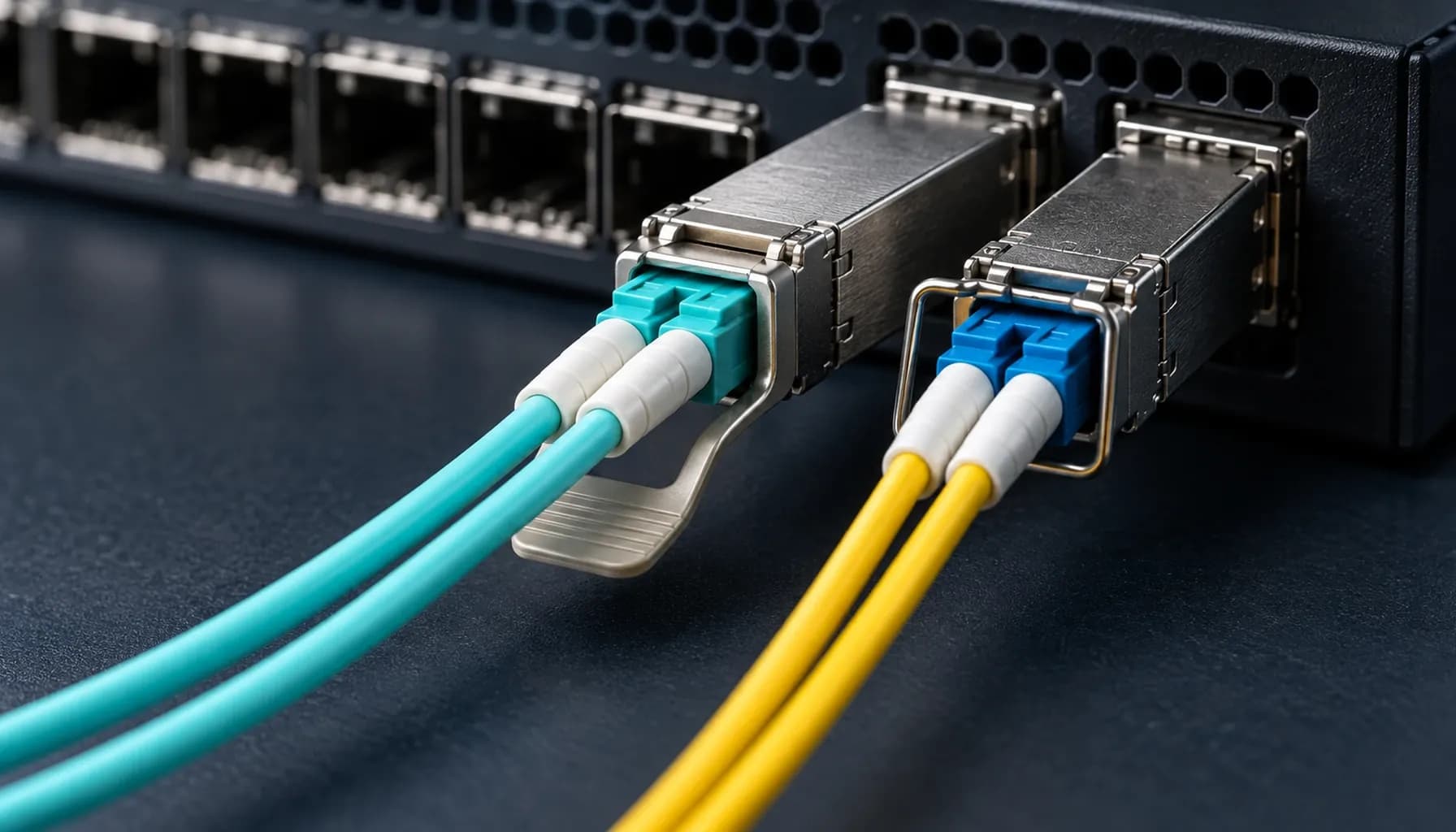
An SFP, SFP+ or SFP28 module exposes identification and diagnostic data through a serial EEPROM. The host reads fields such as connector type, nominal wavelength, vendor name, part number, serial number and supported signalling rate. Modern modules also expose DOM/DDM telemetry: transmit power, receive power, temperature, voltage and laser bias current. The EEPROM does not change the physics of the optic; it tells the host what it is looking at.
Coding should therefore match the intended host family, not merely a vendor label. Confirm the exact switch OS, line-card revision and supported optic class before purchase. A Cisco-coded 10GBASE-SR module may identify cleanly in a Cisco port but still needs an optical and thermal check. For active link monitoring, use the thresholds discussed in our SFF-8472 DOM/DDM diagnostics field guide, rather than treating a green link LED as proof of health.
Start the optical calculation with the available power budget:
$P_{\text{budget}} = P_{\text{Tx\_min}} - S_{\text{Rx\_sens}}$
Then subtract connector loss, fibre attenuation, splice loss and a sensible operational margin. A 10G SR link on OM3 may work at a short patching distance, but it is the wrong answer for a building-to-building run on single-mode fibre. For common 10G and 25G links, Strinex 10G/25G optical transceivers give the starting point; select SR, LR or another optic family from the cable plant and loss budget, not from the port shape.
Comparison matrix
| Parameter | Strinex Alpha Bridge | FS.com Equivalent | Cisco OEM | Generic / Refurbished |
|---|---|---|---|---|
| Host coding | Ordered for the target host and checked before dispatch | Select host coding at order | Native Cisco identity | Often generic or undocumented |
| Traceability | Part and serial recorded for support | Varies by order process | Full OEM traceability | Serial history may be absent |
| DOM/DDM | SFF-8472 telemetry and threshold review | Confirm by selected SKU | Supported on qualified model | Readings can be incomplete |
| Warranty and replacement | Local support path and Dubai stock | Confirm regional return path | OEM RMA process | Seller-dependent |
| Procurement decision | Best fit when coding and local response matter | Viable after host validation | Use where OEM support policy requires it | Avoid for critical links |
The table is deliberately less flattering to refurbished optics. A reused module can pass traffic today while carrying unknown laser hours, questionable EEPROM history, or a contaminated ferrule. That risk belongs in a lab or a low-impact spare pool, not in a core uplink.
Interoperability and host validation
Multi-vendor compatibility is practical, but it demands a disciplined acceptance test. Cisco, Juniper, Arista and MikroTik each expose transceiver inventory and diagnostics differently, and some platforms alert on unsupported optics even when they continue forwarding traffic. Never rely on a copied command from an internet forum to override a host check. Review the vendor documentation and the customer's support policy first; an override can affect future TAC support.
Validate every new optic on the intended switch model and software release. Check module recognition, negotiated speed, DOM values, error counters and link stability under traffic. Record the coding profile in the asset system. This matters more on a leaf switch full of SFP28 ports, where a batch mismatch can turn a straightforward change into a rack-wide incident. If the design is moving to 100G uplinks, compare the fibre and lane requirements in our QSFP28 form-factor guide before standardising the access layer.
Field deployment and maintenance
Most intermittent optic faults arrive at the patch panel, not in the EEPROM. Keep the fibre bend radius above $30\text{ mm}$ unless the cable manufacturer specifies a larger limit. Do not compress a patch lead behind a crowded line card, and do not use the latch as a handle for cable dressing.
Adopt an IEC 61300-3-35 cleaning routine: inspect the ferrule, clean it with an approved dry method, inspect again, then connect it. Repeat that sequence for both ends of the link and for any adapter that has been exposed during the change. Dust, oil and a small scratch can consume the margin that looked comfortable on the spreadsheet.
Capture baseline DOM values after commissioning and compare them during maintenance. A slow receive-power decline is useful evidence; it tells you where to inspect before the link starts flapping in the middle of a shift.
Recommended diagnostic utilities and testing tools
- Fluke Networks FI-7000 FiberInspector Pro checks ferrule cleanliness and damage before an optic is blamed.
- EXFO FTBx-735C OTDR locates fibre events and helps separate a cable fault from a module fault.
- VIAVI SmartClass Fiber OLTS measures insertion loss against the planned link budget.
Frequently asked questions
Does EEPROM coding change the optical performance of an SFP module?
No. EEPROM coding changes the identity and capability information the host reads; it does not change wavelength, launch power or receiver sensitivity. The physical module must still meet its data-sheet specification. Test coding and optics as separate acceptance items.
Can Cisco, Juniper, Arista and MikroTik use the same third-party optic?
Sometimes, but do not assume it. The optic hardware can be the same while the EEPROM profile differs by host. Order the correct coding profile, then validate it on the exact switch and software release before production deployment.
Should we disable unsupported-transceiver warnings?
Only after the customer accepts the support implication and the module passes validation. A warning can be useful evidence of an unsupported inventory change. Suppressing it should not replace a documented qualification process.
How much optical margin should a UAE enterprise link carry?
Use the module data sheet and measured channel loss, then retain enough margin for contamination, temperature and future patching changes. There is no universal number that fits every optic class. Short links can fail with a dirty connector, while long links need careful attenuation accounting.
Are refurbished SFP modules suitable for core links?
They are a poor default for core and industrial links because their operating history and EEPROM provenance may be unclear. Use new, coded modules with a defined warranty where downtime carries operational cost. Refurbished stock can make sense only after inspection and lab testing for a non-critical spare role.
Key takeaways and UAE selection checklist
- Match the optic family to the installed fibre and measured loss budget; do not select SR or LR by price alone.
- Specify the target host coding, switch software version and port type on the purchase request.
- Capture baseline DOM/DDM values after commissioning and investigate threshold drift before a link fails.
- Keep bend radius above $30\text{ mm}$ and follow IEC 61300-3-35 inspection and cleaning practice.
- Pay for traceability and warranty on links that carry core, storage or SCADA traffic.
Conclusion and local UAE procurement
Third-party SFP coding works when it is treated as controlled configuration, not a shortcut around a vendor warning. Specify the host, calculate the optical budget, validate the module in the destination platform and preserve the test record. That process gives a UAE operations team a supportable network instead of a drawer of anonymous optics.
For urgent replacements, local Dubai stock and same-day dispatch matter as much as the module price. Review the live Strinex 10G/25G optical transceiver product page for the current option, then provide the switch model, port speed, fibre type and required reach when requesting coded stock.