
Introduction
An optical link rarely fails without leaving evidence. In a Dubai Internet City data centre, a 10G uplink may stay up while receive power drifts toward its low alarm. In an Abu Dhabi SCADA network, cabinet heat can push a marginal optic past the temperature at which its laser bias begins to climb. If nobody reads the module telemetry, both faults arrive as a link flap and a late-night dispatch.
SFF-8472 digital diagnostics monitoring, usually called DOM or DDM, gives engineers a view of the optic rather than just the switch port state. Treat that data as a trend source, not a green-light test. A value inside the factory alarm range can still be wrong for the installed channel.
Technical operating principles and optical budget
SFF-8472 exposes calibrated or internally calculated transmit power, receive power, laser bias current, temperature and supply voltage through the SFP EEPROM management interface. Hosts present the fields in their own units, but the engineering rule is consistent: compare like with like, record a baseline after acceptance, then investigate movement rather than a single reading.
The first calculation is the usable optical-power budget:
$P_{\text{budget}} = P_{\text{Tx_min}} - S_{\text{Rx_sens}}$
For a nominal 10GBASE-LR channel, if the transmitter minimum is -8.2 dBm and receiver sensitivity is -14.4 dBm, the budget is 6.2 dB. That number must cover fibre attenuation, connector loss, splices, patch panels and a reserve for contamination or future work. DOM Rx power tells you what remains at the receiver; it does not replace loss testing.
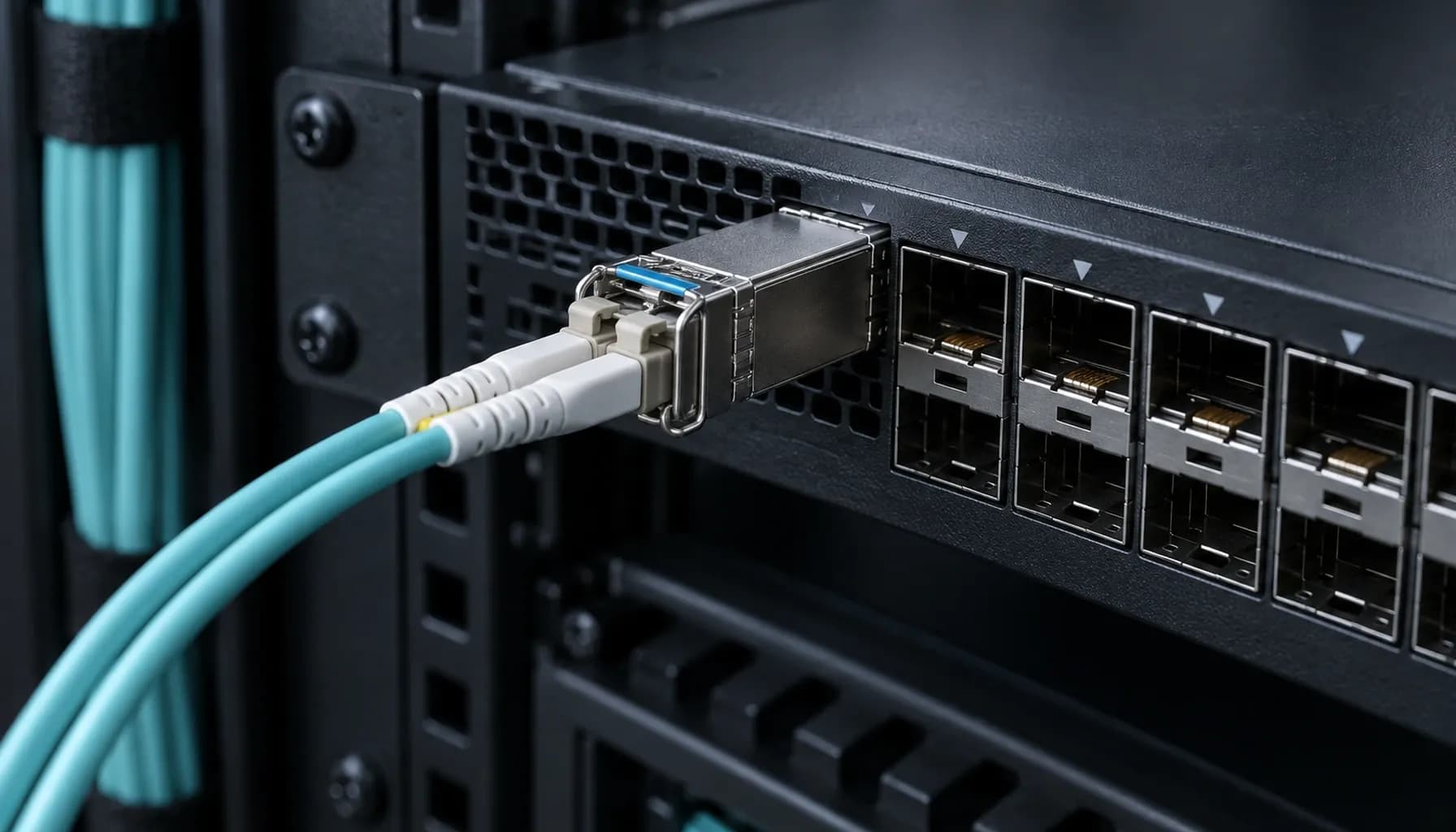
For short rack or row links, an Alpha Bridge ASFP-10G-SR optical transceiver paired with the correct OM3/OM4 plant is usually the clean answer. For campus and control-room circuits, use OS2 and LR optics when the path requires it. Do not choose single-mode merely because it sounds more capable; a short multimode channel with the right optic is simpler to troubleshoot.
Comparison matrix
| Parameter | Strinex Alpha Bridge | FS.com Equivalent | Cisco OEM | Generic / Refurbished |
|---|---|---|---|---|
| DOM fields | Tx/Rx power, bias, temperature, voltage | Confirm per selected SKU | Confirm per qualified PID | Verify EEPROM and calibration |
| Host coding | Match host and rate before ordering | Select vendor code explicitly | Native vendor coding | History and coding may be unclear |
| Optical budget work | Use data sheet minima and measured loss | Same calculation required | Same calculation required | Do not trust label alone |
| Warranty and traceability | Local support and documented supply | Confirm regional terms | Vendor support route | Provenance varies |
| UAE deployment fit | Practical for stocked 1G/10G spares | Lead time varies by order | Costly for spare pools | Risk belongs to the operator |
An OEM label does not improve a dirty connector, and a low-price spare does not help if its DDM values cannot be trusted. Buy optics that fit the host policy and maintain a known-good spare for each critical channel.
Interoperability and host validation
Cisco, Juniper, Arista and MikroTik expose transceiver telemetry differently. SFF-8431 defines the SFP+ electrical and management interface; SFF-8472 specifies diagnostics, calibration and alarm thresholds. Start with a supported host release, a port set to the intended rate, and an optic coded for the host where its platform enforces vendor checks. Then read DOM values at both ends after warm-up.
Validate the channel in this order: module identity and EEPROM checksum, host recognition, link training, DOM baseline, and error counters under real traffic. A normal Rx level with incrementing FCS errors often points to a rate, FEC, electrical, or host-side problem rather than fibre loss. For the wider vendor rules, use the published SFP+ compatibility guide for Cisco, Juniper and Arista. For 25G circuits, pair the DOM review with the 25G SFP28 FEC modes guide.
Do not set fleet-wide thresholds from a transceiver data sheet alone. A -12 dBm receive reading might be healthy on a 10 km LR circuit and suspicious on a 20 m fibre route. Build warning thresholds from the installed link's commissioning readings, then leave enough margin before the module's own alarm limit.
Field deployment and maintenance
Physical discipline still decides many “optical” incidents. Keep a fibre bend radius above $30\text{ mm}$ unless the cable manufacturer specifies a larger limit. Respect that radius inside shallow patch trays and behind high-density line cards, where a door closure can turn a neat patch into a stressed loop.
Inspect and clean every mating pair before commissioning and after any unexplained power change. IEC 61300-3-35 provides the inspection framework: examine the ferrule end face, clean it with the approved dry or wet-dry method, inspect again, then connect. Never clean only the patch lead and ignore the transceiver receptacle. Record the port, serial number, Tx/Rx values and test date in the handover pack.
A sudden 1 to 2 dB Rx drop after a cabinet change is usually a physical clue. Check polarity, connector cleanliness, bend pressure and patching before declaring the optic bad. The field-testing guide for OTDR and optical link diagnostics explains where an OTDR helps and where a power meter is the quicker instrument.
Recommended diagnostic utilities and testing tools
- EXFO FTBx-735C Optical Power Meter for measured loss and live power checks at the correct wavelength.
- Fluke Networks FI-7000 FiberInspector Pro for ferrule inspection before a questionable connector goes back into service.
- VIAVI SmartOTDR for locating loss events and breaks on longer fibre routes.
Frequently asked questions
What does SFF-8472 monitor in an SFP module?
It typically reports transmit power, receive power, laser bias current, temperature and supply voltage. Exact fields and calibration behavior depend on the module. Read the data sheet and host output together before treating any reading as comparable across vendors.
Is a DOM value inside the alarm range always healthy?
No. Factory thresholds protect the module, not the design margin of your particular fibre channel. A link can sit above low alarm while degrading from its commissioning baseline. Use trend-based warning limits and investigate meaningful movement.
Why does high laser bias current matter?
Rising bias current can indicate an ageing laser or temperature compensation at work. It is most useful when compared with the optic's earlier readings at a similar ambient temperature. Replace the module when the trend is sustained and the link margin is shrinking, not after one warm afternoon.
Can Cisco, Juniper, Arista and MikroTik read the same DOM data?
They can usually read the core SFF-8472 fields, but command syntax, display units and third-party optic policy vary. Validate the actual host release and port mode during staging. Capture output from both ends of a production circuit for the handover record.
When should an engineer use an OTDR instead of DOM?
Use DOM for continuous endpoint telemetry and an OTDR to locate events along the fibre. DOM can show that receive power fell; it cannot identify the bad splice or pinched section. For a short patching fault, inspection and a power meter are often faster than either.
Key takeaways and UAE selection checklist
- Commission every critical optical channel with recorded Tx, Rx, temperature and bias values at both ends.
- Calculate budget from guaranteed transmitter minimum and receiver sensitivity, then preserve a realistic loss reserve.
- Set local warning thresholds from the commissioned channel, not solely from the module alarm fields.
- Keep bends above $30\text{ mm}$ and use IEC 61300-3-35 inspection and cleaning before connection.
- Validate optics on the intended Cisco, Juniper, Arista or MikroTik host before field deployment.
Conclusion and local UAE procurement
DOM earns its place when it leads to earlier, narrower fault isolation. Baseline the channel, trend Rx power and bias, and inspect the physical layer before replacing hardware. That routine works in dense Dubai data halls and industrial SCADA cabinets because it makes the evidence visible before the circuit fails.
For replacement stock, match the wavelength, reach, fibre type, host coding and DOM requirement to the installed channel. Strinex maintains Dubai stock for common optics and can arrange same-day dispatch where inventory and delivery cut-off permit. Check the live Alpha Bridge ASFP-10G-SR product page for the current listing and confirm the host and fibre details with the order.