
Dubai Internet City data centres and Abu Dhabi industrial SCADA estates expose the same mistake in different forms: teams choose fibre by cable price, then discover that optics or the route makes the decision expensive. Start with the installed plant, the longest permanent link, and the optical budget.
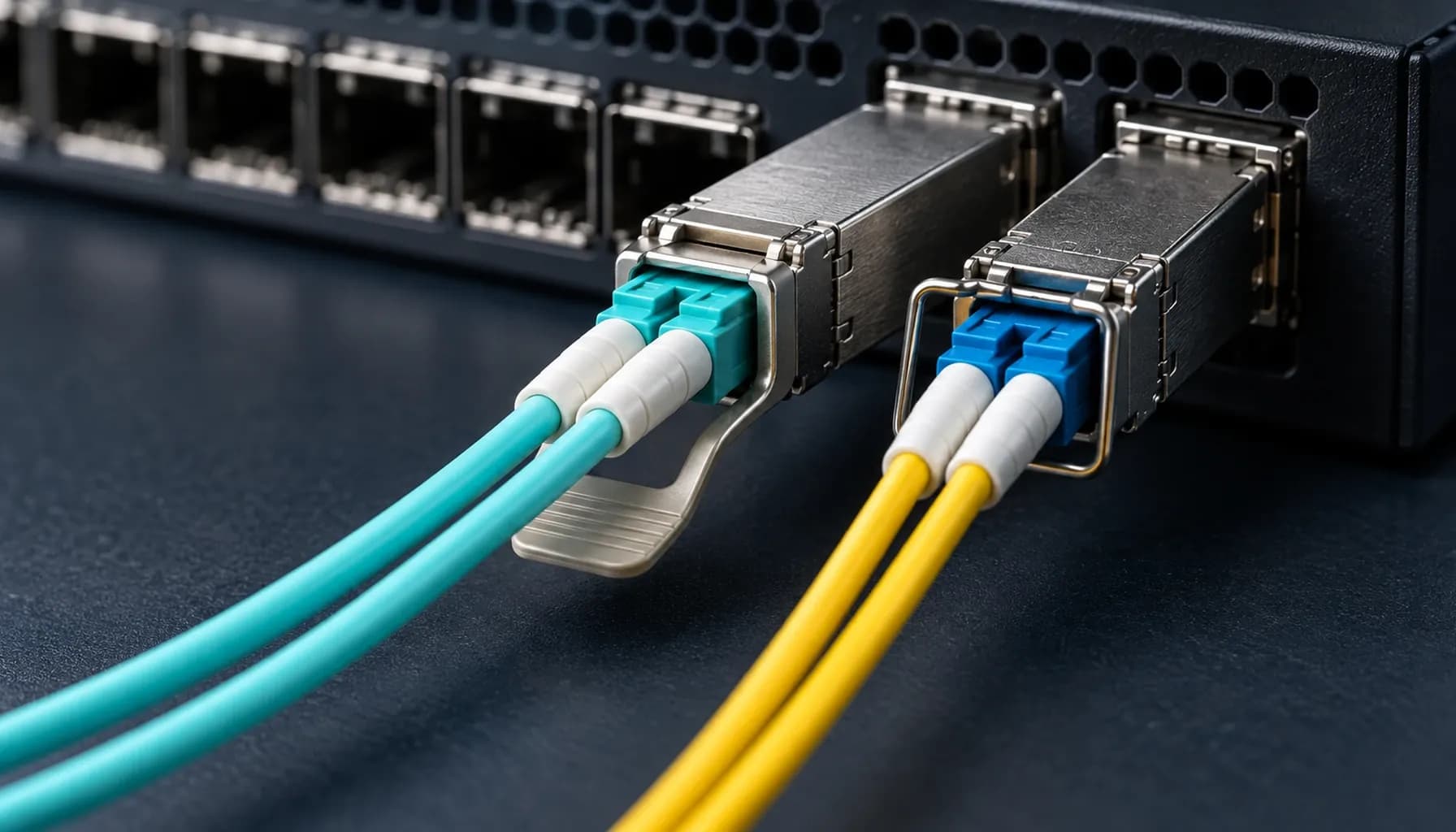
OS2 is the default for new campus, metro, and building-to-building routes in the UAE. OM3 and OM4 still make sense in contained equipment rooms with short, predictable 850 nm links. They are different transmission systems with different failure modes and cost curves.
Operating principles, reach and loss budget
OS2 single-mode fibre has an approximately 9 µm core and normally carries 1310 nm or 1550 nm optics. Its low attenuation and lack of modal dispersion make it the rational choice beyond the data-hall boundary. OM3 and OM4 use a 50 µm core and 850 nm VCSEL optics, where modal bandwidth sets practical reach.
Use 300 m for OM3 and 400 m for OM4, subject to the installed channel class and vendor data sheet. A 10GBASE-LR optic is specified for 10 km over OS2. Build the budget before ordering optics: $P_{\text{budget}} = P_{\text{Tx\_min}} - S_{\text{Rx\_sens}}$. Deduct fibre attenuation, connector pairs, splices, and a margin for dirt, ageing, and the next patch panel.
For a new OS2 backbone, pair the route with a compatible Strinex 10G/25G optical transceiver only after confirming wavelength, reach, connector type, and host coding.
Comparison matrix
| Parameter | Strinex Alpha Bridge | FS.com Equivalent | Cisco OEM | Generic / Refurbished |
|---|---|---|---|---|
| OS2 long-reach option | Verify LR or 20 km SKU, 1310 nm | Select exact LR/ER variant | Qualified LR optic | Validate label and test report |
| OM3/OM4 short-reach option | Verify SR SKU, 850 nm | Select exact SR variant | Qualified SR optic | Confirm actual wavelength |
| Host coding | Confirm Cisco, Juniper, Arista or MikroTik target | Order coded variant | Native coding | Often unknown or locked |
| DDM telemetry | Check SFF-8472 support | Check module data sheet | Platform dependent | Frequently inconsistent |
| UAE supply and warranty | Local stock and support | Confirm lead time and return path | Confirm channel stock | Verify provenance and warranty |
A brand name does not repair a mismatched wavelength or an exhausted loss budget. Cisco OEM can be a conservative procurement path, but it does not remove the need to validate DOM readings, fibre type, and the switch release in use.
Interoperability and host validation
Cisco, Juniper, Arista, and MikroTik ports need matching speed, wavelength, connector, and fibre mode at both ends. Verify SFF-8431 host interface and SFF-8472 diagnostic support before treating a module as interchangeable. Cisco and Juniper platforms may enforce vendor EEPROM checks; a permissive port is not proof of a healthy link. Record the host model, release, optic part and serial number, DDM thresholds, and measured receive power during staging. For coding constraints and EEPROM checks, see Third-Party SFP Module Coding & EEPROM Programming. Use the SFF-8472 DOM/DDM diagnostics field guide to interpret telemetry against the module data sheet.
Field deployment and maintenance
Treat bend radius as an optical requirement. Hold a minimum installed bend radius above $30\text{ mm}$ for patch leads unless the manufacturer specifies a larger limit. Inspect every ferrule before mating and follow IEC 61300-3-35: dry clean first, use wet-to-dry cleaning when contamination persists, inspect again, and cap exposed connectors.
Recommended diagnostic utilities and testing tools
- Fluke Networks FiberInspector Pro checks ferrule end faces before a connector consumes the link budget.
- EXFO MaxTester OTDR locates splice, connector, and bend events on OS2 routes.
- VIAVI SmartClass Fiber OLP-88 measures end-to-end insertion loss and optical power for acceptance testing.
Frequently asked questions
Should a new UAE campus backbone use OS2?
Yes, unless the route is permanently confined to short data-hall links with a clear OM3 or OM4 standard. OS2 preserves options for 10 km LR optics and later capacity changes without replacing the cable plant. Specify the optic reach for the actual route and retain usable margin.
Is OM4 always better than OM3?
OM4 offers more effective modal bandwidth and a longer 10GBASE-SR channel than OM3. It does not turn 850 nm multimode into a campus technology or compensate for dirty connectors. Use it where the extra reach or high-speed roadmap has documented value.
Can a Cisco switch use a third-party optic?
Many Cisco models can, subject to platform policy, release, coding, and support rules. Stage the exact optic in the intended port and confirm link, DOM, alarms, and error counters. Keep an approved spare with identical coding, not merely the same wavelength.
How much loss margin should a fibre design retain?
Calculate every fixed loss first, then reserve a practical margin for contamination, ageing, and future cross-connects. The exact allowance depends on the optic specification and maintenance regime. A design that only passes on paper will fail first during a dusty maintenance window.
Why does a link fail after an apparently clean installation?
Most short fibre faults come from contaminated ferrules, reversed polarity, tight bends, or incompatible optics. Inspect both ends and compare transmit and receive power with the module data sheet. If those checks pass, use insertion-loss testing or OTDR traces to isolate the event.
UAE selection checklist
- Choose OS2 for backbone, campus, and inter-building routes; use OM3 or OM4 for short controlled data-centre channels.
- Calculate the optical budget and deduct every connector, splice, fibre kilometre, and engineering margin.
- Validate optic, host coding, firmware, DOM thresholds, and receive power before dispatch.
- Keep patch-lead bends above $30\text{ mm}$ and follow IEC 61300-3-35 cleaning practice.
Conclusion and local UAE procurement
OS2 is the sensible long-life cable plant for UAE backbone work; OM3 and OM4 earn their place in short, dense equipment-room links. Strinex holds local Dubai stock for selected optical modules and can support same-day dispatch where stock and order cut-off permit. Review the live 10G/25G optical transceiver range and match the module to the tested host and measured fibre channel.