
Introduction
A top-of-rack link is a channel, not a commodity cable. In a Dubai Internet City data centre, the wrong assembly usually announces itself at the worst time: a dense line card starts logging errors after a cabinet move, or a short server link refuses to train at the planned rate. Copper direct-attach cables (DACs) and active optical cables (AOCs) both remove the separate optic-and-patch-lead interface. They solve different physical problems.
Use passive DAC inside the rack when the port rate, length and routing are within the host's supported channel. It is cheap, low power and mechanically tough. Use AOC when the run leaves the rack, crosses electrically noisy plant, or turns cable weight and airflow into an operational problem. Do not buy AOC merely because it sounds more advanced. A short, well-routed passive DAC is usually the cleaner design.
Technical operating principles and power budget
A passive DAC carries the electrical SerDes signal over twinax copper with no active equalisation in the cable. Its loss rises with frequency and length, so the host transmitter, receiver equaliser and cable gauge must agree. An active DAC adds conditioning electronics and may extend the supported reach, but it also draws power and remains a copper channel.
An AOC converts the electrical lane to light inside each terminated end, sends it through fixed fibre, then converts it back. That is why it weighs less, tolerates electromagnetic interference, and reaches farther than DAC. The fixed ends are also why a damaged AOC is normally replaced as an assembly rather than repaired in the field.
For an optical AOC, start acceptance with the conservative link-budget expression $P_{\text{budget}} = P_{\text{Tx\_min}} - S_{\text{Rx\_sens}}$. Available budget must exceed fibre attenuation, connector loss, splice loss and engineering margin. The manufacturer data sheet decides the actual numbers; never infer them from cable length alone. For DAC, inspect the published host-and-cable reach matrix and error counters instead of applying an optical budget.
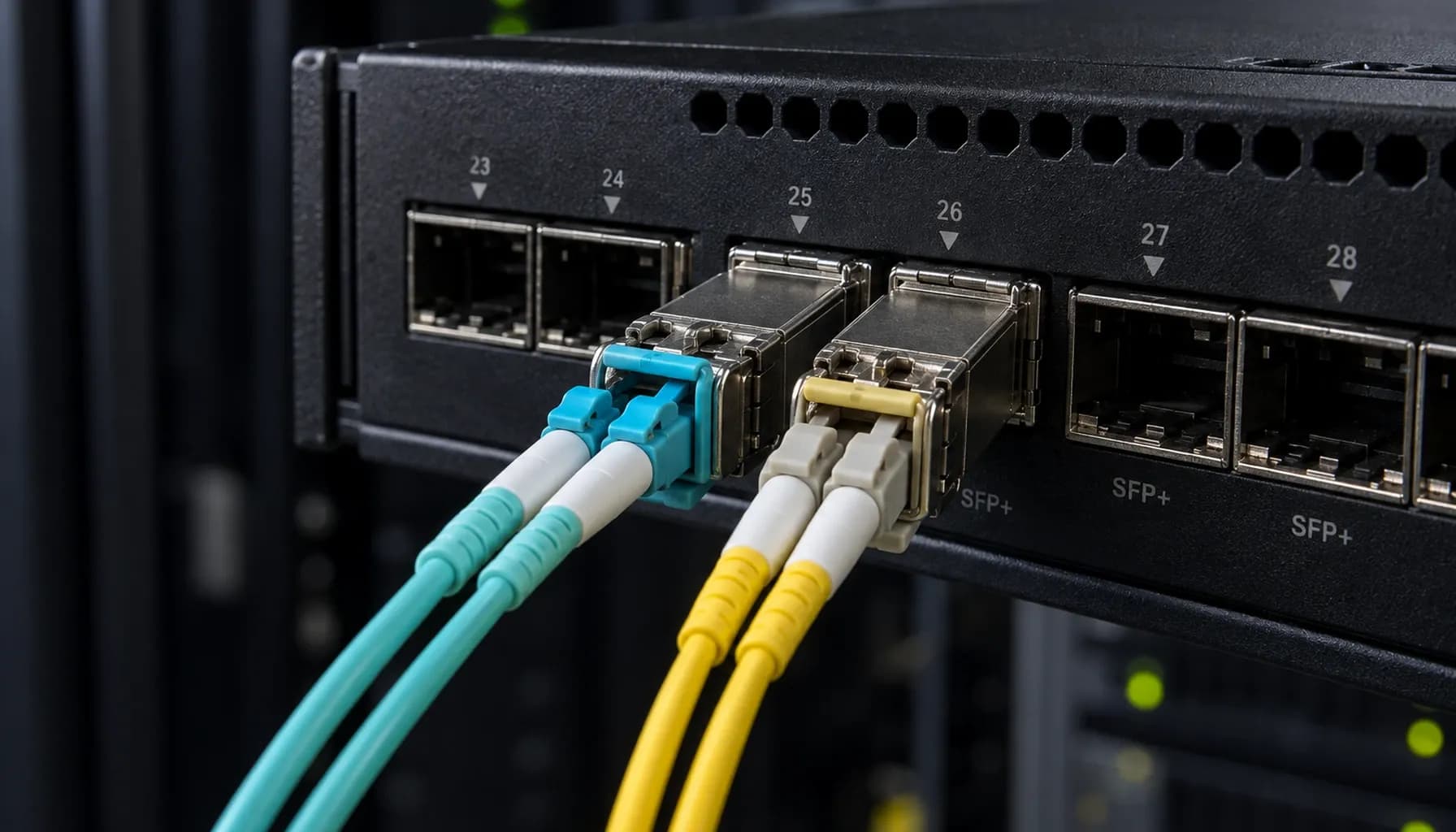
For uplinks that must use separate optics and structured fibre, the Alpha Bridge ASFP-10G-SR optical transceiver is a sensible 850 nm, LC-duplex starting point. It is not a substitute for an AOC, but it gives the operator a serviceable optic and patching boundary.
Comparison matrix
| Parameter | Strinex Alpha Bridge | FS.com Equivalent | Cisco OEM | Generic / Refurbished |
|---|---|---|---|---|
| Form factor and coding | Confirm SFP+/SFP28/QSFP host coding before order | Confirm selected coded assembly | Qualified coding and support path | Coding and EEPROM provenance vary |
| Passive DAC use | Best for short, supported in-rack copper channels | Comparable when host code matches | Predictable on listed hosts | Validate length, gauge and host support |
| AOC use | Prefer for inter-rack reach, lower mass and EMI exposure | Comparable when data rate and code match | Qualified option at OEM pricing | Treat end electronics and warranty as unknowns |
| Power and thermals | Passive DAC draws no cable power; AOC draws module power | Check data sheet | Check platform power budget | Verify actual draw and temperature rating |
| UAE delivery and warranty | Check Dubai stock and written replacement terms | Confirm import lead time | Confirm local channel lead time | Confirm testing record and return path |
The table is deliberately unsentimental. The label is less important than a qualified channel, traceable coding and a supplier willing to replace a failed assembly. Refurbished cables can work, but they are a poor choice for a new production row where a nuisance outage costs more than the saving.
Interoperability and host validation
Cisco, Juniper, Arista and MikroTik switches do not interpret every coded DAC or AOC identically. Match form factor, lane count, breakout method, data rate, forward-error-correction policy and approved length to the exact port. SFF-8431 defines the SFP+ electrical and management interface, but it does not make every cable EEPROM acceptable to every operating system.
Before a change window, test one production-equivalent cable in each host model. Record DOM or cable EEPROM fields where available, interface counters, negotiated speed and FEC state. Run bidirectional traffic long enough to expose symbol errors. The SFP+ compatibility guide for Cisco, Juniper and Arista covers the host-side discipline in more detail. Do not force a port setting just to make a link light; find the mismatch.
Field deployment and maintenance
DAC rewards tidy routing. Respect the cable supplier's bend specification, avoid crushing a bundle under a rail, and leave strain relief at both latches. AOC needs more care at the optical section: maintain a bend radius above $30\text{ mm}$ unless its data sheet explicitly permits tighter routing. Tight ties and sharp cabinet turns can create intermittent loss that looks like a switching fault.
AOCs are sealed assemblies, yet their ends and mating ports still collect contamination. Use the IEC 61300-3-35 inspection sequence: inspect the ferrule or port, dry-clean it with the correct tool, inspect again, then mate. Never clean blind and never connect a visibly contaminated interface. In Abu Dhabi industrial SCADA rooms, dust control and labelled spare assemblies are often worth more than another round of software troubleshooting.
Recommended diagnostic utilities and testing tools
- Fluke Networks FiberInspector Pro for inspecting fibre end faces before an AOC or optic is connected.
- VIAVI SmartOTDR for locating loss events on structured fibre paths when the issue is beyond a fixed AOC.
- EXFO MaxTester 720C for acceptance and troubleshooting of fibre spans supporting ToR uplinks.
Frequently asked questions
Is DAC or AOC better for an in-rack server link?
Passive DAC is usually better when the run is short and the switch vendor qualifies that cable length and rate. It uses no cable power and survives ordinary rack work well. Choose AOC only when weight, routing congestion or electrical noise makes copper the weaker channel.
Can an AOC replace a transceiver and patch lead?
Yes, if the required length, connector arrangement and host coding are available as one fixed assembly. You lose the ability to swap only the optic or only the patch lead later. Use separate optics where structured cabling or independent spares matter more than simplicity.
Do active DACs need a switch power budget check?
Yes. Their conditioning electronics consume power from the port, and dense line cards have thermal and per-port limits. Confirm the cable's maximum draw and the platform's supported active-cable policy before filling a row.
Why does a cable link up but show errors under traffic?
A trained link only proves that the endpoints found a signalling mode. Error bursts can come from an unsupported cable length, poor bend control, FEC mismatch, contaminated optical interfaces or marginal host equalisation. Check counters during sustained bidirectional traffic and compare the cable with a known-good qualified sample.
Can I use the same AOC across Cisco, Juniper, Arista and MikroTik?
Sometimes, but never assume it. The physical connector can fit while EEPROM coding or the host qualification policy rejects the assembly. Validate a representative cable on each exact switch model and software release before a fleet purchase.
Key takeaways for UAE selection
- Use passive DAC for short, qualified in-rack channels; it is usually the lowest-risk and lowest-power choice.
- Select AOC for longer ToR runs, EMI exposure and cable-management pressure, then validate the fixed assembly on the target host.
- Check optical AOC budget with $P_{\text{budget}} = P_{\text{Tx\_min}} - S_{\text{Rx\_sens}}$ and check copper assemblies against the host reach matrix.
- Keep AOC bends above $30\text{ mm}$ unless the data sheet says otherwise, and follow IEC 61300-3-35 inspection and cleaning practice.
- Treat coding, FEC, counters and sustained traffic as acceptance criteria, not paperwork.
Conclusion and local UAE procurement
Choose the simplest qualified physical layer. Passive DAC owns short in-rack links. AOC earns its place where reach, EMI immunity and low cable mass justify the extra cost. Validate the exact cable, host software and port policy before deployment, then retain a known-good spare for each critical row.
For Dubai projects that need local stock and same-day dispatch, check the live Alpha Bridge ASFP-10G-LR product page for current specification and availability. For fault isolation after installation, use the optical fibre field-testing and OTDR guide rather than guessing at the physical layer.