
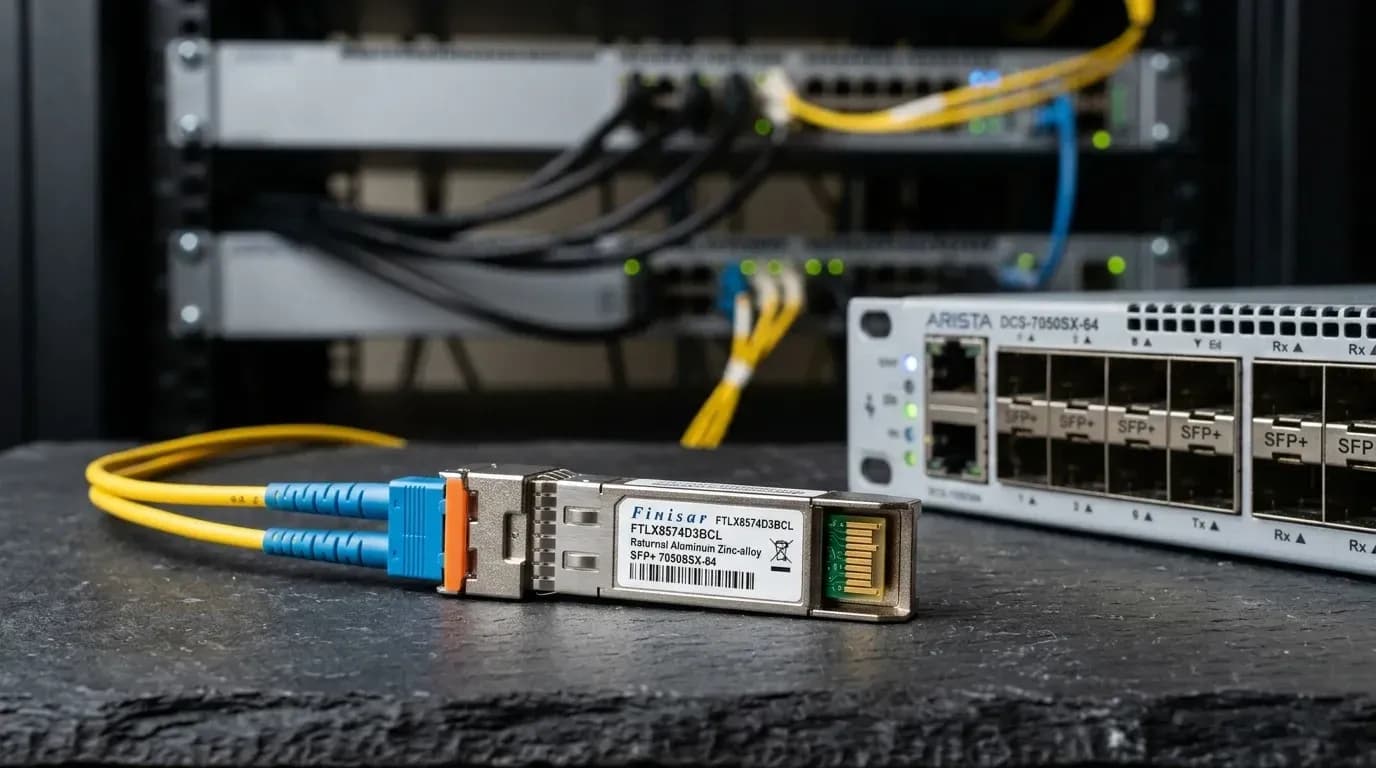
SFP+ Compatibility on Cisco, Juniper & Arista Switches: UAE Guide

Freshly racked enterprise switches across the GCC routinely reject third-party optics with a %PHY-4-SFP_NOT_SUPPORTED syslog message, leaving engineers scrambling for OEM SKUs while a 4–7 day overseas air freight stretches into a second week of link downtime. The root cause is rarely hardware failure — it is vendor-coded EEPROM validation embedded at memory address 0xA0 of every pluggable module. This guide, the practical SFP+ Compatibility on Cisco, Juniper & Arista Switches: UAE Guide, documents exactly how standards-compliant 10G optics such as the Alpha Bridge ASFP-10G-SR integrate into modern campus and data-center fabrics, and how to bypass vendor lockouts without violating warranty terms. Engineers in the UAE procurement market also need to weigh laser wavelength physics, fiber reach, and SFF-8472 monitoring telemetry before committing to a part number.
---
Standards, Wavelengths & Optical Power Budget
A 10GBASE-SR SFP+ module like ASFP-10G-SR uses an 850 nm VCSEL laser launched into OM3 or OM4 multimode fiber, engineered to IEEE 802.3ae Clause 52 with a minimum 2.6 dB optical power budget over 300 m. Its long-reach sibling, the Alpha Bridge ASFP-10G-LR, transmits at 1310 nm over OS2 single-mode fiber and carries a 6.2 dB budget across 10 km. Both modules expose full Digital Diagnostic Monitoring (DDM/DOM) telemetry across memory map 0xA2, reporting module temperature, Vcc supply voltage, Tx bias current, Tx optical launch power, and Rx optical receiver power in real time. SFF-8472 Rev 12.4 standardizes this five-channel telemetry interface, which gives NOCs the visibility to detect laser aging before a link fails.
The link budget equation is straightforward but unforgiving:
$$P{\text{budget}} = P{\text{Tx\min}} - S{\text{Rx\_sens}}$$
Where Tx_min is the minimum guaranteed launch power of the transceiver in dBm and Rx_sens is the receiver sensitivity threshold. Cisco, Juniper, and Arista switches all normalize these values out of SFF-8472 and present them through CLI. A healthy 10GBASE-SR link should report an Rx power figure at least 3 dB above the receiver sensitivity floor; anything closer indicates a contaminated LC duplex ferrule, an excessive bend radius, or a fiber approaching end-of-life. For 1G legacy uplinks, the Alpha Bridge ASFP-1G-LX operates at 1310 nm over OS2 up to 10 km and exposes identical DOM telemetry, which simplifies fleet-wide monitoring scripts.
Key Takeaway: Never deploy a 10G SFP+ optic without first polling show interface transceiver (or the platform equivalent) and confirming that received power sits at least 3 dB above the Rx sensitivity threshold — this is the only way to guarantee a sub-10⁻¹² bit-error-rate over a multi-year operational lifespan.
---
Hardware Comparison: Strinex Alpha Bridge vs. FS.com vs. Cisco OEM vs. Generic

| Parameter | Strinex Alpha Bridge | FS.com Equivalent | Cisco OEM | Generic / Refurbished |
|---|---|---|---|---|
| **Data Rate** | 1G / 10G / 25G options | 1G / 10G / 25G options | Typically single speed SKU | Variable, often unmarked |
| **Wavelength / Fiber** | 850 nm MM (OM3/OM4) or 1310 nm SM (OS2) | Same | Same | Same — laser aging unverified |
| **Max Reach** | 300 m (SR) / 10 km (LR) | 300 m / 10 km | 300 m / 10 km | Often overstated |
| **DDM / DOM Support** | Full SFF-8472 across 0xA2 | Full SFF-8472 | Full SFF-8472 | Inconsistent or absent |
| **MSA Compliance** | SFF-8431 + SFF-8472 | SFF-8431 + SFF-8472 | SFF-8431 + SFF-8472 | Unverified EEPROM |
| **UAE Delivery Time** | Same-day ex-stock Dubai warehouse | 4–7 business days international transit | 7–14 days via distributor chain | Unpredictable |
| **UAE Warranty / RMA** | Regional RMA desk in UAE (verify current term on portal) | Overseas return-to-factory | OEM advance replacement | 30–90 days limited |
The headline commercial differentiator is fulfillment latency. During a switch reboot loop or a hot-swap failure in Dubai, waiting 4–7 days for FS.com's overseas courier versus dispatching from a Dubai warehouse is the difference between a four-hour outage and a regional SLA breach. Refurbished Cisco modules from Server Basket typically ship faster but offer thin warranty coverage and undisclosed laser degradation history; an over-aged 1310 nm FP laser can pass show interface transceiver at first boot and develop bit errors six months later.
---
Multi-Vendor Switch Compatibility & Interoperability
MSA compliance is the unifying layer beneath every multi-vendor deployment. Both SFF-8431 (mechanical and electrical) and SFF-8472 (diagnostic interface) were authored before any switch vendor's EEPROM validation logic, so a module that strictly implements these standards is mechanically and electrically interchangeable. On Cisco IOS-XE and NX-OS, the host reads bytes 3–10 of the 0xA0 page to derive the vendor part-number string; if it does not match an internal database, the port errors out. The official bypass per the Cisco IOS-XE System Management Configuration Guide is the global configuration command service unsupported-transceiver, typically paired with no errdisable detect cause sfp-config-error. This does not void Cisco SmartNet on the chassis itself — it only suppresses the third-party module alert.
Juniper Junos on EX4300 and QFX5100 platforms is more permissive by default: a non-Juniper-coded module either operates normally or produces a yellow alarm without dropping the link. Arista EOS on the 7050SX and 7280R series accepts any MSA-compliant optic without CLI overrides; the platform simply logs a vendor mismatch as informational. MikroTik RouterOS on the CCR2216 and CRS504 reads raw DDM but does not enforce vendor validation, making it the most permissive target in the matrix. Across all four vendors, SFF-8472 DOM telemetry remains fully visible at the CLI — engineers should always verify this at installation time rather than trusting the link LED alone.
For engineers building mixed-fabric topologies — a common pattern at UAE edge sites where aggregation switches from one vendor meet access switches from another — the Alpha Bridge ASFP-10G-SR Optical Transceiver interoperates uniformly across IOS-XE, Junos, EOS, and RouterOS without per-platform firmware adjustments.
---
Field Deployment, Insertion Loss & Optical Fiber Maintenance
Physical installation should follow a disciplined sequence. First, inspect every LC duplex ferrule with a 200× inspection scope against the IEC 61300-3-35 pass/fail criteria before insertion; contamination caught here is the single largest cause of link flaps. Second, maintain a bend radius greater than 30 mm (10× the 3 mm OM3/OM4 cable jacket diameter) across the entire patch run — macrobends past this threshold elevate insertion loss dB exponentially rather than linearly. Third, clean both ends of every patch cord using a one-click cleaner rated for LC UPC connectors, even on factory-fresh cables.
Total channel attenuation is the sum of fiber attenuation (≈ 3.0 dB/km at 850 nm for OM3), connector insertion loss (≤ 0.3 dB per mated pair), and splice loss (≤ 0.1 dB per fusion splice). For a 100 m OM3 run with two patch panels, total attenuation lands near 1.0 dB — well within the 2.6 dB IEEE budget and leaving comfortable margin. For a 10 km OS2 LR link with four patch panels and one fusion splice, total attenuation is roughly 5.5 dB, again safely under the 6.2 dB budget but with very little recovery if a panel gets contaminated.
Once installed, validate Tx and Rx power at both ends with a calibrated optical power meter. Record the readings into the change-management ticket. Finally, poll DDM through the switch CLI (show interface transceiver detail on IOS-XE, show interfaces diagnostics optics on Junos, show interfaces transceiver on EOS) and confirm operating temperature is within the 0 °C to 70 °C commercial envelope, or specify industrial-grade (-40 °C to +85 °C) optics for outdoor UAE cabinet deployments.
---
Recommended Diagnostic Utilities & Testing Tools
- Fluke Networks SimpliFiber Pro — Calibrated optical power meter with auto-wavelength detection and LC/SC/ST bulkheads for production-grade link certification.
- EXFO FIP-435B Fiber Inspection Probe — Automated IEC 61300-3-35 pass/fail analysis with on-board storage; the de facto standard for data-center ferrule inspection.
- Viavi SmartPocket V2 OLS — Handheld stabilized laser source with both 850 nm and 1310 nm sources for end-to-end attenuation sweeps.
---
Frequently Asked Questions
What is the maximum transmission reach of 10GBASE-SR vs 10GBASE-LR?
10GBASE-SR over OM3 reaches 300 m, while 10GBASE-SW over OM4 extends to 400 m. 10GBASE-LR over OS2 reaches 10 km. Real-world reach depends on connector count and patch-panel density — always calculate span attenuation against the 2.6 dB / 6.2 dB IEEE budgets.
Can I use a 1000BASE-SX module over single-mode fiber?
No. The 850 nm VCSEL in a 1000BASE-SX module couples poorly into the 9 µm core of OS2 fiber and produces unpredictable loss; the SM fiber is engineered for 1310 nm sources. Use a 1000BASE-LX module for any single-mode application.
Can 1000BASE-LX operate over legacy OM1 or OM2 multimode fiber?
Only with a mode-conditioning patch cord on each end. The 1310 nm Fabry-Perot laser in 1000BASE-LX launches a mode pattern that differential mode delay distorts across OM1's 62.5 µm core; the mode-conditioning cable offsets this offset insertion loss.
How do I configure third-party SFP modules on Cisco Catalyst switches?
Enter global configuration and run service unsupported-transceiver, then no errdisable detect cause sfp-config-error. The link will come up and SFF-8472 DOM telemetry will be fully visible through show interface transceiver detail.
Where can I buy SFP+ modules with same-day delivery in Dubai?
Verify current stock on the Strinex UAE product portal; same-day ex-stock dispatch is available for orders placed before the Dubai cut-off time. Local replacement warranty terms are listed alongside each SKU.
---
Key Engineering Takeaways
- MSA First, Vendor Second — Confirm SFF-8431 + SFF-8472 conformance before evaluating any 10G SFP+ optic. Vendor-coded EEPROM is the only thing that differs between compliant modules.
- 3 dB Operating Margin Is Non-Negotiable — Always verify received power sits at least 3 dB above Rx sensitivity at installation and after every patch-panel move.
- Match Laser to Fiber — 850 nm VCSEL for OM3/OM4; 1310 nm FP/DFB for OS2. Crossing wavelengths and fiber types produces losses no power budget can absorb.
- Industrial Temp for Outdoor Cabinets — Specify -40 °C to +85 °C transceivers for any UAE outdoor enclosure; commercial 0 °C to 70 °C modules fail in shaded summer ambients.
- Local Fulfillment Beats 4–7 Day Air Freight — Match your switch-recovery SLA to the transceiver vendor's shipping profile, not their sticker price.
- --
Conclusion & Regional UAE Procurement
Selecting standards-compliant SFP+ optics across Cisco, Juniper, Arista, and MikroTik platforms reduces to three engineering decisions: match the laser wavelength to the fiber plant, hold a 3 dB operating margin against the IEEE power budget, and confirm SFF-8472 DOM telemetry at every installation. The Alpha Bridge ASFP-10G-SR satisfies all three requirements at MSA level while delivering same-day ex-stock Dubai dispatch for UAE enterprise networks. For longer campus or inter-building runs, pair it with the Alpha Bridge ASFP-10G-LR on the OS2 trunk side. UAE procurement teams should verify current warehouse inventory and RMA terms directly on the Strinex portal before finalizing rack-of-network orders.
Related Engineering Guide: BiDi SFP+ 10G Single-Strand Deployment Guide (UAE, 2026)