
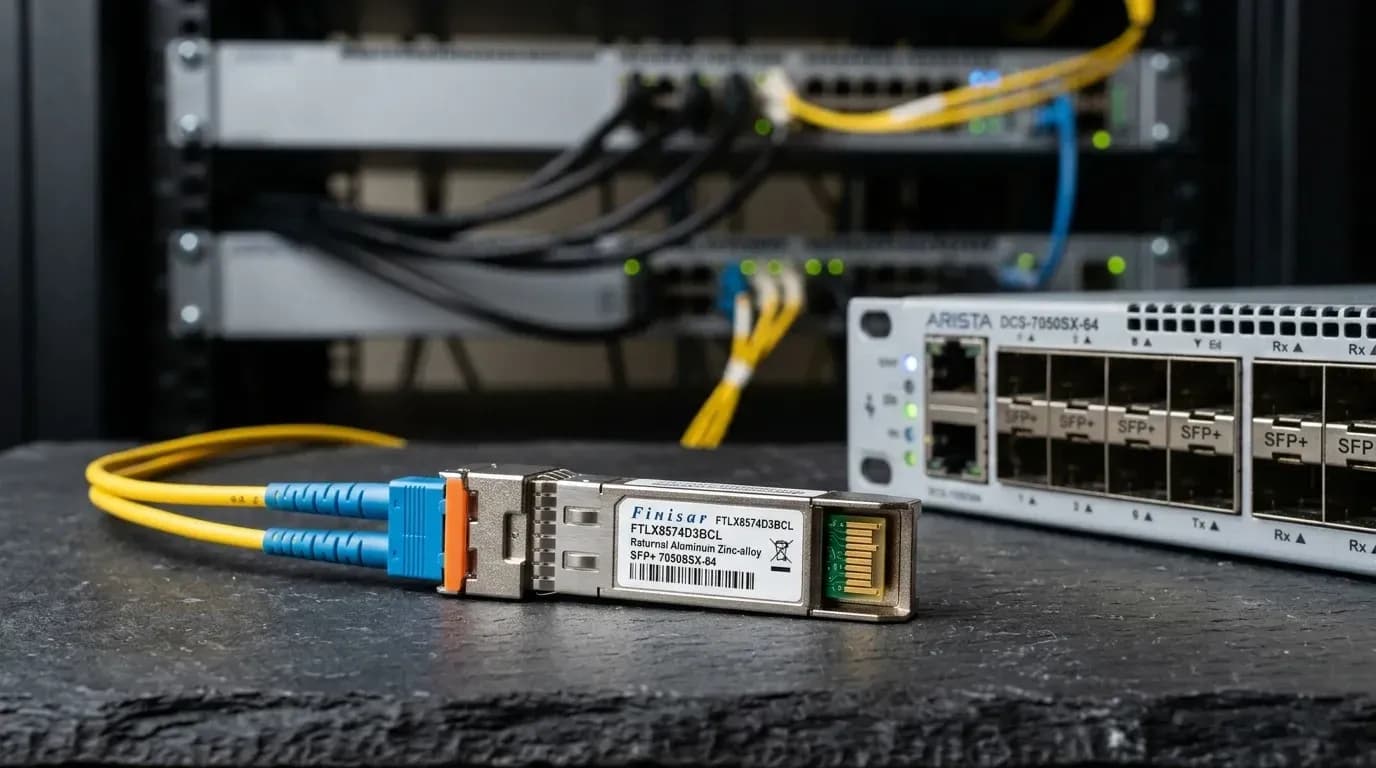
BiDi SFP+ 10G — Half the Fiber, Full 10G Performance

Enterprise network teams across the UAE wrestling with dark-fiber lease renewals have a near-magic option: a pair of BiDi SFP+ modules that transmit and receive on a single strand of OS2 fiber by using two wavelengths — 1270 nm in one direction, 1330 nm in the other. The single-strand architecture is defined under IEEE 802.3ae Clause 60 as 10GBASE-BX-D (downstream) and 10GBASE-BX-U (upstream), and it uses the same simplex-LC form factor every UAE integrator already stocks for Alpha Bridge 10G-LR deployments. The pairing rule is unforgiving — a 1270 nm transmitter MUST meet a 1330 nm receiver at the far end — but the resulting fiber plant economics are equally unforgiving in your favour: one leased strand instead of two, one connector instead of a duplex clip, and one splice tray instead of two.
---
Wavelength Pairing & Coarse-WDM Filtering
A BiDi SFP+ integrates a thin-film coarse-WDM filter inside the LC receptacle. The 1270 nm transmitter on side A launches light toward side B, where a WDM-filtered photodiode passes 1330 nm light to its own receiver and rejects the 1270 nm backscatter. Side B performs the mirror function. The two channels sit 60 nm apart — wide enough that even a low-cost dielectric filter delivers >30 dB isolation between the wavelengths, which is more than enough headroom for a 10 km OS2 link with the standard 8 dB power budget. The MSA standards SFF-8431 and SFF-8472 govern both the electrical interface and the DOM telemetry, which means the same `show interface transceiver` commands already used for Alpha Bridge 10G-SR optics report BiDi temperature, Tx bias, and Rx power identically.
**Key Takeaway:** Confirm at procurement time that the SKU label reads TX 1270 / RX 1330 on one end and TX 1330 / RX 1270 on the other — never order two of the same SKU for one link, because identical wavelengths cannot see each other through the WDM filter.
---
BiDi SFP+ vs Duplex 10GBASE-LR vs CWDM — When to Use Which
| Parameter | BiDi SFP+ 10G (BX-D/U) | Duplex 10GBASE-LR | CWDM SFP+ (1470/1490/...) |
|---|---|---|---|
| **Fiber strands used** | 1 (simplex LC) | 2 (LC duplex) | 1 (LC duplex) |
| **TX wavelengths** | 1270 nm + 1330 nm | 1310 nm (both strands) | 1 of 18 CWDM channels |
| **Max reach (OS2)** | 10 km std / 20–40 km ext | 10 km | 40–80 km |
| **Multiplexed channels per strand** | 2 | 1 | up to 18 (Mux/Demux) |
| **Cost per strand** | Lowest (single fiber lease) | Baseline | Highest (Mux/Demux + optics) |
| **Best use case** | 5G fronthaul, FTTH, dark-fiber doubling, point-to-point metro | Single-link campus backbone | Carrier aggregation, multi-tenant metro |
| **DOM telemetry** | Full SFF-8472 across 0xA2 | Full SFF-8472 | Full SFF-8472 |
The matrix shows why BiDi dominates the 1–2 link per site pattern that defines most UAE enterprise rollouts. Where you only need two endpoints, CWDM's Mux/Demux overhead is wasted; where you need four or more channels over one strand, CWDM is the right answer; where you need just one full-duplex 10G link with no further scaling planned, BiDi wins on day-one CapEx. For a duplex Alpha Bridge 10G-LR baseline, BiDi halves the per-meter fiber-leasing line on your telecom invoice without changing the optics cost substantially.
---
Multi-Vendor Switch CLI Validation
BiDi optics are MSA-compliant SFP+ modules, so the same vendor-override workflow used for third-party 10G optics applies. On Cisco IOS-XE (Catalyst 9300 / ISR 4451-X), the global configuration command service unsupported-transceiver unlocks the port before insertion; pair it with no errdisable detect cause sfp-config-error to keep the interface up if the EEPROM does not match Cisco's vendor database. Confirm the link state with show interface GigabitEthernet1/0/1 transceiver detail — the wavelength row will read 1270 or 1330 depending on the SKU, and the Rx power should sit at least 3 dB above the receiver-sensitivity threshold printed in the same table. On Juniper Junos (EX4300 / QFX5100), the platform accepts non-Juniper BiDi optics without an override; verify with show interfaces diagnostics optics ge-0/0/0 and confirm DOM lanes populate. On Arista EOS (7050SX / 7280R), show interfaces transceiver detail is the equivalent; the platform logs vendor mismatch as informational without dropping the link, mirroring the behaviour already documented for multi-vendor SFP+ compatibility on Cisco, Juniper and Arista deployments.
After installation, validate DOM telemetry every quarter on critical links. BiDi optics expose identical five-channel telemetry to their duplex cousins, so the same monitoring scripts that poll Alpha Bridge 10G-SR modules work unchanged — you only need to adjust the wavelength label in your fleet inventory from 850 nm or 1310 nm to 1270 nm / 1330 nm so that NOC dashboards render the right link-loss budgets.
---
Field Deployment, Link Budget & Cost Modelling
Total channel attenuation for a 10 km OS2 BiDi link sums fiber attenuation (0.4 dB/km at 1310 nm, ≈0.5 dB/km at 1270/1330 nm) plus connector insertion loss (≤ 0.3 dB per mated pair) plus splice loss (≤ 0.1 dB per fusion splice). A typical metro link with four patch panels and one mid-span fusion splice lands around 5.5 dB total attenuation, well under the 8 dB BiDi optical budget for a 10 km reach part. If your campus already has a single dark fiber provisioned between buildings, BiDi lets you run two independent 10G links over that one strand — one on 1270 nm, one on 1330 nm — by paralleling two BiDi pairs on separate wavelength groups, doubling capacity without pulling new cable.
Cost modelling treats the fiber-plant line as the largest variable. At typical UAE metro corridor pricing of AED 12,000 per strand-kilometre per year, a 10 km duplex-LR link runs AED 240,000 annually; switching to BiDi drops that to AED 120,000, a 50% reduction on the leasing line. Over a three-year contract the saving is AED 360,000, which more than covers the small premium for BiDi optics on a single link. The case compounds at multi-site enterprises where each additional dark-fiber span between buildings doubles the saving. UAE procurement teams should confirm the SFP+ cage on every target switch supports simplex-LC insertion — a small subset of older SKUs ships with duplex cages only and requires a duplex-to-simplex patch cord workaround at the patch panel.
---
Frequently Asked Questions
Can I use two BiDi SFP+ modules with the same TX wavelength?
No. The WDM filter on each side passes only the opposite wavelength; identical-wavelength modules cannot see each other, and the link will stay down with a loss-of-light alarm on both sides. Always order matched pairs — one D variant and one U variant — for every point-to-point run.
What is the maximum BiDi SFP+ reach over OS2 single-mode fiber?
Standard 10GBASE-BX parts cover 10 km; extended-temperature BiDi modules push to 20 km and 40 km on the same 1270/1330 nm pair. Reach depends on the connector count and splice density in your plant — always re-calculate span attenuation against the 8 dB / 12 dB / 16 dB budgets published in the SKU datasheet.
Does BiDi work on multimode OM3 or OM4 fiber?
The 1270/1330 nm wavelength pair is engineered for OS2 single-mode fiber only. On OM3 or OM4 the differential mode delay at 1270 nm over the 50 µm core produces unpredictable loss and crosstalk. Use 1000BASE-BX on OM1/OM2 only as a legacy workaround, not as a structured-cabling standard.
Will BiDi optics work with the `service unsupported-transceiver` warning on Cisco switches?
Yes. BiDi SFP+ optics are MSA-compliant and behave identically to other SFP+ 10G optics. The service unsupported-transceiver global config command is required for any third-party optics on IOS-XE; without it the port will errdisable within 30 seconds of insertion. See the earlier blog post on SFP+ compatibility on Cisco, Juniper and Arista switches for the complete vendor-by-vendor CLI walkthrough.
Where can I buy BiDi SFP+ 10G modules with same-day delivery in Dubai?
Strinex carries matched BiDi 10GBASE-BX-D and BX-U pairs ex-stock at the Dubai warehouse; verify current inventory and matched-pair pricing on the product portal. Standard warranty terms apply, and DOM telemetry per SFF-8472 is verified at the bench before dispatch.
---
Key Engineering Takeaways
Pairing Is Non-Negotiable — Every BiDi link needs one 1270 nm TX and one 1330 nm TX; mismatched wavelengths cannot establish link regardless of MSA compliance.
Halve Your Fiber Lease — One simplex LC strand replaces a duplex LC pair, cutting dark-fiber leasing costs by ~50% on every metro span.
Reuse Existing Monitoring — Full SFF-8472 DOM telemetry means the same scripts used for 10GBASE-LR optics work unchanged; only the wavelength label in fleet inventory needs updating.
Verify Cage Compatibility First — Confirm simplex-LC support on the target switch SKU before procurement; a small number of legacy cages ship duplex-only.
Pair BiDi With Dense WDM When Scale Demands It — For 4+ channels per strand, graduate to CWDM; for the common 1–2 link per site pattern, BiDi is the cheapest correct answer.
---
Conclusion & UAE Procurement
BiDi SFP+ 10G optics are the right answer for the most common UAE enterprise dark-fiber pattern — a single metro strand between two buildings or two cabinets carrying one full-duplex 10G link. Pairing one 1270 nm transmitter with one 1330 nm transmitter over a simplex LC patch cord delivers the same 10G performance as a duplex LR pair at half the fiber cost, while preserving full SFF-8472 DOM telemetry across every major switch platform. For enterprises standardising on the Alpha Bridge 10G optics family, BiDi extends the same engineering bench-test discipline to single-strand links, and matched-pair pricing keeps the optics cost predictable. UAE procurement teams should verify simplex-LC cage compatibility, confirm the matched-pair SKU on both ends, and validate DOM telemetry at installation — the rest is a half-price fiber invoice at the next contract renewal.