
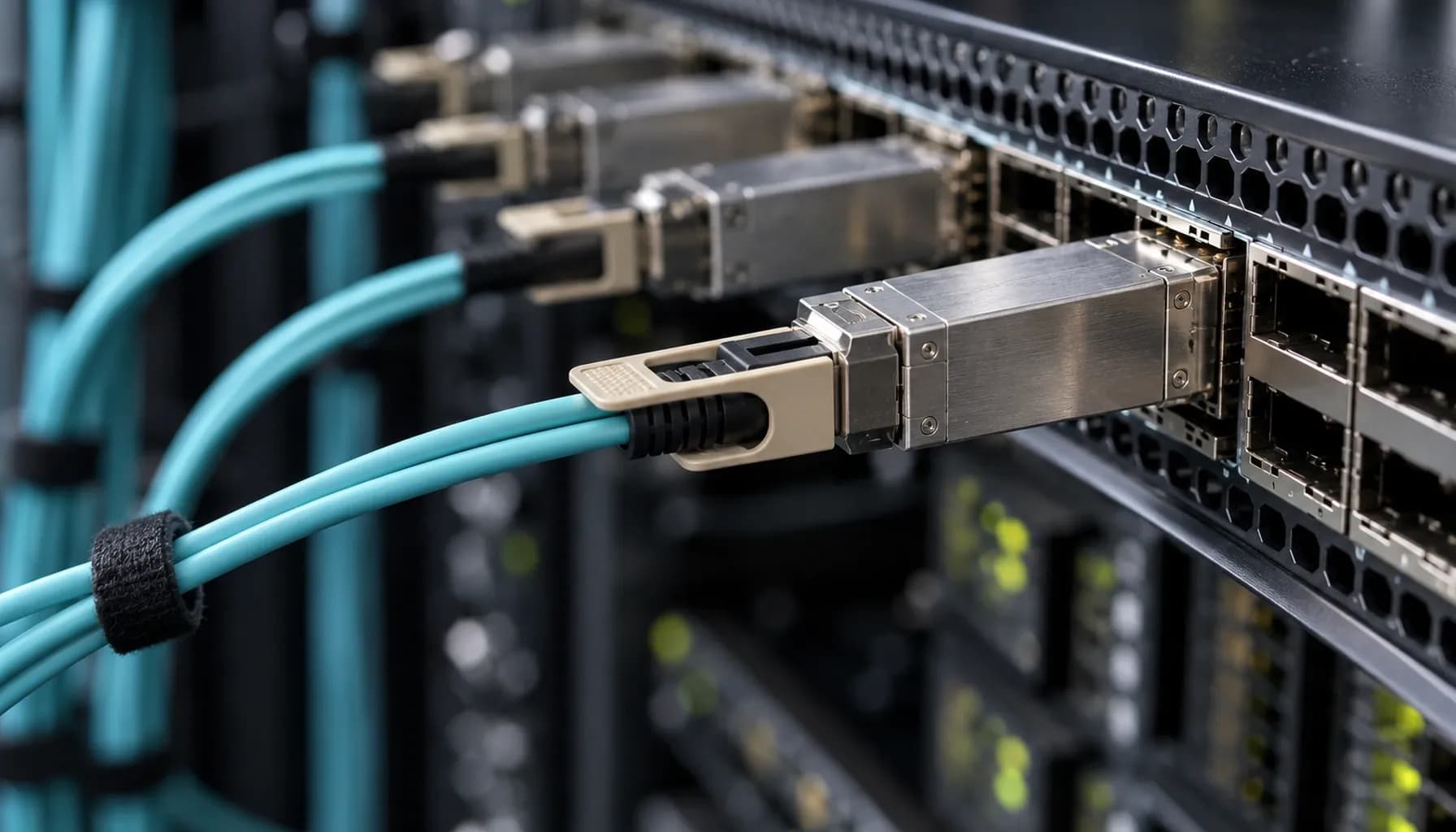
BiDi SFP+ Transceivers: Maximizing Fiber Capacity with Single-Strand WDM in the UAE (2026)
A BiDi SFP+ single-strand fiber optic transceiver is the optimal solution when upgrading to 10G requires utilizing a single available OS2 fiber strand instead of a full pair. This technology transmits and receives data on distinct wavelengths through a single simplex LC connection, provided both ends are configured as a matched WDM pair and the channel meets the required optical budget.
For environments like Dubai's data centers, campus risers, and remote facilities in Abu Dhabi, BiDi transceivers often present a more efficient alternative to installing additional fiber. However, it's important to note that this is not a straightforward replacement for generic SFP+ modules. Factors such as wavelength direction, connector quality, historical loss factors, and switch EEPROM configurations are critical to ensuring stability.
Understanding WDM Simplex Technology, Reach, and Optical Budget
BiDi optics integrate WDM multiplexing/demultiplexing with a 10G SFP+ transceiver engine. Typically, one end transmits at 1270 nm and receives at 1330 nm, while the opposite end reverses these wavelengths. Both ends utilize single-mode OS2 fiber and simplex LC connectors, making them a directional pair that is not interchangeable. Specifications for reach should be selected based on the data sheet, typically offering options for 10 km or 20 km.
To calculate the optical budget, use the formula: \[ P_{\text{budget}} = P_{\text{Tx_min}} - S_{\text{Rx_sens}} \] Deduct fiber attenuation, connector pairs, splices, and reserve an additional 3 dB for safety. For example, a 10 km OS2 path with approximately 0.4 dB/km attenuation and four connector pairs at 0.5 dB each results in a total loss of about 6 dB. With a 10 dB budget, this leaves a 4 dB margin, whereas a 7 dB budget would not suffice. Unforeseen losses from splitters or patch panels can erode this reserve.
BiDi is not suitable for multimode OM3/OM4 fiber; instead, use paired 10GBASE-SR modules for such applications. Ensure that the modules support SFF-8472 DDM/DOM for monitoring temperature, voltage, bias, and power levels via the I2C address 0xA2. For product selection, refer to the Strinex 10G/25G Optical Transceivers catalog, and always verify the BiDi pair and platform compatibility before purchasing.
Key takeaway: BiDi links save fiber strands only when each endpoint is configured with the correct opposing wavelength and the channel maintains at least a 3 dB measured margin.
High-Density Hardware Comparison Matrix
| Parameter | Strinex Alpha Bridge | FS.com Equivalent | Cisco OEM | Generic / Refurbished |
|---|---|---|---|---|
| **Data rate / power rating** | 10G SFP+; platform-specific budget | 10G SFP+; model dependent | 10G SFP+; model dependent | Often unclear or unverified |
| **Wavelength / fiber type** | Matched 1270/1330 nm pair; OS2 simplex | Matched BiDi pair; OS2 simplex | Matched BX pair; OS2 simplex | Pairing labels may be inconsistent |
| **Max reach / range** | Specify 10 km or 20 km against loss budget | Usually 10 km/20 km by SKU | Cisco-qualified reach by PID | Claim often not traceable to test data |
| **DDM / DOM telemetry** | SFF-8472 telemetry expected and checked | Typically available by SKU | Supported on compatible platforms | May be absent or poorly calibrated |
| **Switch compatibility** | Coded and validated before dispatch | Coding selectable at order time | Native Cisco PID only | EEPROM origin uncertain |
| **UAE delivery time** | Ex-stock Dubai, same-day dispatch when available | Usually 4–7 days overseas | Channel-stock dependent | Stock and provenance vary |
| **Regional warranty** | Local Strinex support and regional warranty | Seller terms apply | Cisco support contract terms | Frequently limited or absent |
Traceability is crucial: a seemingly inexpensive optic can become costly if the remote wavelength is incorrect or if telemetry cannot detect declining Rx power. Always stage labeled A/B pairs and retain a DOM baseline. For more on DOM/DDM diagnostics, refer to the SFF-8472 DOM/DDM Diagnostics: A UAE Engineer's Field Guide to Reading SFP Optical Telemetry (2026).
Multi-Vendor Switch Compatibility and Interoperability
While SFF-8431 electrical compliance and SFF-8472 diagnostics facilitate interoperability, they do not override vendor-specific EEPROM policies. Cisco Catalyst/Nexus, Juniper EX/QFX, Arista 7050SX, and MikroTik RouterOS can operate compliant 10G optics, but factors like qualification, port mode, and software release are critical.
Cisco and Arista may permit an override for unsupported transceivers, but this should be used only as a documented exception, not to mask light-level faults. On Juniper devices, always prefer approved coding. After MikroTik RouterOS upgrades, verify the link state and DOM, as commands vary by release. Validate them before implementing change control:
1Cisco IOS XE: service unsupported-transceiver2Cisco NX-OS: service unsupported-transceiver3Arista EOS: service unsupported-transceiverThis command cannot rectify wavelength mismatches, faulty patch leads, or low Rx power. Always read the EEPROM and DOM at both ends and compare against the data sheet. For detailed guidance, consult the SFP+ Transceiver Compatibility on Cisco, Juniper & Arista Switches: The Complete UAE Engineering Guide (2026).
Field Deployment, Insertion Loss, and Maintenance
Pair each module as “1270 Tx / 1330 Rx” and “1330 Tx / 1270 Rx”; install one of each. Record serial numbers, DOM readings, route details, and patch-panel identifiers. Maintain a bend radius above 30 mm and avoid tightly cinching OS2 cables behind dense line cards.
Follow IEC 61300-3-35 standards: inspect, dry-clean, inspect, and mate the connectors. Validate both directions using an optical power meter; use OTDR to locate events and OLTS to verify end-to-end loss. A link-up only indicates that current Rx is above the threshold, not that the required margin is present.
Recommended Diagnostic Utilities & Testing Tools
Begin with inspection, establish loss with OLTS, identify anomalies with OTDR/VFL, and then compare DOM with the baseline. Remember, DOM is operational telemetry, not a certification of the channel.
- Fluke Networks FiberInspector Pro inspects LC end-face contamination before it contributes to insertion loss.
- Fluke Networks CertiFiber Pro OLTS measures bidirectional fiber loss against the selected reference method.
- EXFO MaxTester 720C OTDR locates breaks, reflectance, and event loss on installed single-mode routes.
Frequently Asked Questions
Do BiDi SFP+ modules work over a single fiber strand?
Yes. A matched pair uses separate transmit and receive wavelengths over one OS2 strand. The modules must be complementary A/B wavelengths; two with the same transmit wavelength will not form a circuit.
Can I use a BiDi SFP+ module with OM3 fiber?
No. BiDi 10G SFP+ modules are designed for single-mode OS2 fiber; their wavelength and power assumptions do not align with OM3. Use paired SR modules for short multimode links unless explicitly certified otherwise.
What optical margin should a UAE 10G BiDi circuit maintain?
Retain at least 3 dB after accounting for measured channel loss. This reserve accommodates connector aging, minor repairs, and temperature-induced movement without operating at the receiver threshold. More margin is advisable on routes with multiple patch fields or uncertain legacy splices.
Does DOM prove that the fiber channel is certified?
No. DOM displays the module’s operating measurements and is excellent for trend monitoring. Certification requires an appropriate OLTS test with a reference method, and OTDR is used to investigate anomalous events. Record both test data and initial DOM values at handover.
Should engineers enable unsupported-transceiver commands?
Only after confirming physical compatibility and obtaining policy approval. The override can bypass vendor qualification restrictions but cannot correct optics, loss, or EEPROM defects. Use correctly coded modules for production whenever possible and document any exception in change control.
Selection Checklist for UAE Network Teams
- Specify complementary 1270/1330 nm endpoint pairs, OS2 simplex fiber, and the actual required reach.
- Calculate the power budget, measure channel loss, and ensure at least a 3 dB margin is retained.
- Confirm SFF-8431/SFF-8472 behavior along with the exact software policy for Cisco, Juniper, Arista, or MikroTik.
- Clean and inspect LC ferrules before each connection; record OLTS and DOM baselines during commissioning.
- Purchase traceable matched pairs with local support rather than treating wavelength-labeled optics as commodity singles.
Buy Against the Measured Channel
BiDi SFP+ extends 10G capacity where adding a second fiber strand is impractical. Success hinges on using a matched wavelength pair, ensuring EEPROM compatibility, and verifying the channel with adequate margin.
For UAE teams, procure the bidi sfp+ single-strand fiber optic transceiver based on the loss report and switch inventory, and keep the A/B pair together through staging. Strinex offers local UAE supply from its Dubai warehouse, including ex-stock same-day dispatch where available, along with regional warranty support. Confirm the compatible 10G/25G transceiver requirement with Strinex before deployment.