
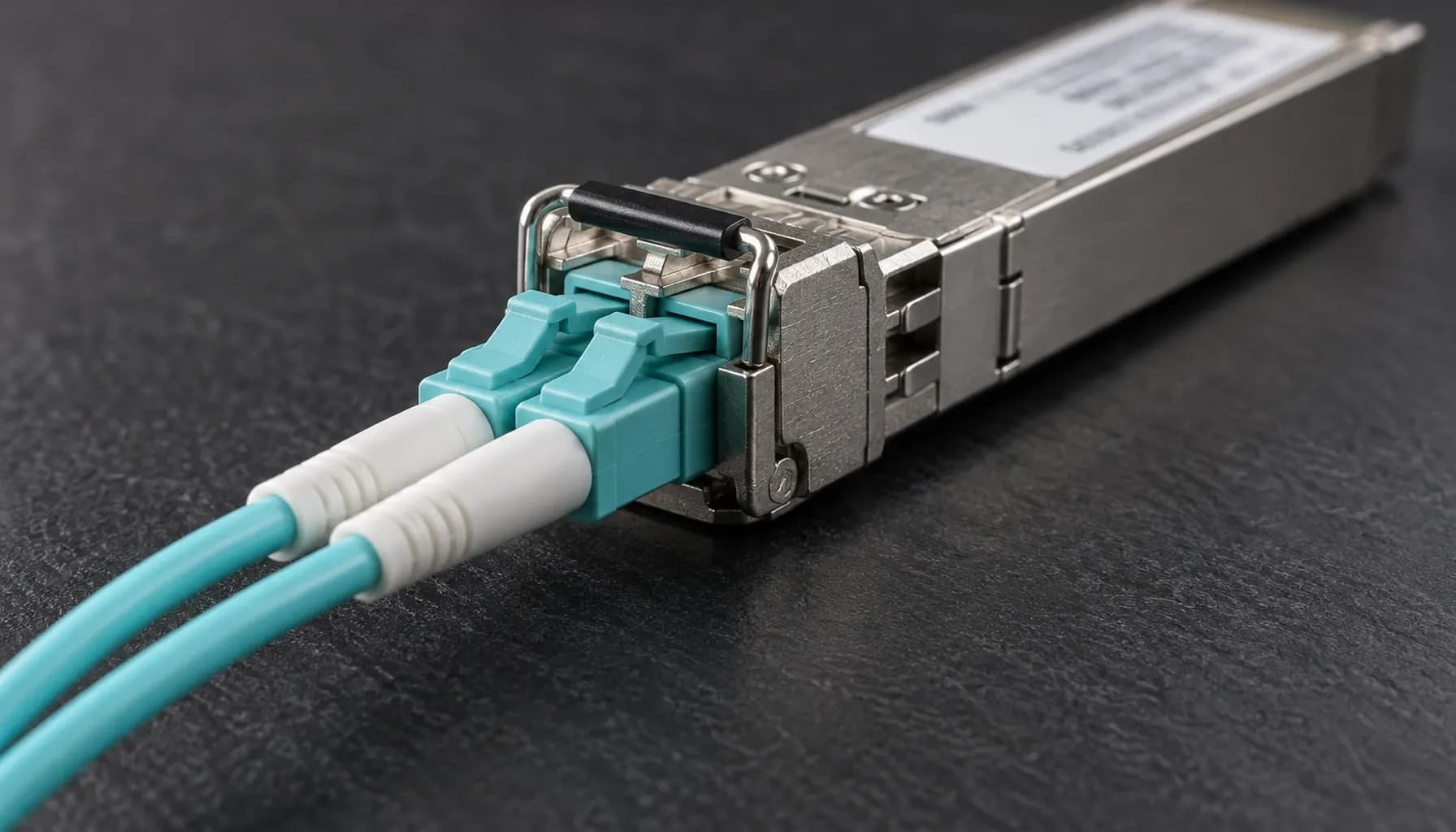
Why FEC configuration breaks 25G links
A 25G link can show light, negotiate a port, and still drop traffic because the hosts disagree about FEC. It is common on high-density Dubai Internet City line cards, where DACs, AOCs and SFP28 optics share a switch family but not the same PHY expectations. Hosts choose FEC.
Treat FEC as a link-pair setting. Both ends must advertise and run the same supported mode, then prove the result with counters and a traffic test. A link that comes up only after forcing a mode is not automatically healthy; it may be operating without the margin that the channel needs.
Technical operating principles and optical margin
Base-R and RS-FEC do different jobs
Base-R FEC, often called Firecode FEC, adds modest overhead and corrects limited error patterns with low latency. It suits clean, short channels where the host supports it. RS-FEC uses Reed-Solomon coding across symbols and has better tolerance for burst errors, at the cost of overhead and latency. On 25GbE, engineers usually encounter the IEEE 802.3 RS-FEC family on electrical lanes and DAC-style channels. Support is platform and port-group specific, so the switch data sheet remains the authority.
Do not turn on RS-FEC merely because it sounds safer. It can rescue a marginal electrical channel, but it cannot correct an incompatible optical wavelength, a dirty LC ferrule, or a receive level below sensitivity. It also changes the latency and the error-counter baseline. For low-latency traffic, use the vendor-recommended mode on a clean channel.
Start with the loss budget, then use DDM as evidence
FEC protects the bit stream; it does not create optical power. For an SFP28 optical design, calculate the available margin first:
$P_{\text{budget}} = P_{\text{Tx\_min}} - S_{\text{Rx\_sens}}$
Subtract fibre attenuation, mated-pair loss, splices and a maintenance reserve from that result. A 25GBASE-SR run on OM4 has a very different channel limit from a 25GBASE-LR run on OS2, even though both use SFP28 cages. Keep at least 3 dB of practical margin where the optics and channel specification permit it. A link designed right to the receiver threshold will become a recurring fault as connectors age and cabinet temperatures move.
Read SFF-8472 DDM/DOM telemetry after acceptance: module temperature, supply voltage, laser bias, Tx power and Rx power. Baseline those values, then trend them. Falling Rx alongside rising corrected-codeword counters points to the physical path. Flat optics with FEC mismatch alarms point to host configuration. For short-reach deployments, confirm DDM fields and form factor before installation: Alpha Bridge ASFP-10G-SR optical transceiver.
Comparison matrix
| Parameter | Strinex Alpha Bridge | FS.com Equivalent | Cisco OEM | Generic / Refurbished |
|---|---|---|---|---|
| FEC planning | Confirm host, media and approved FEC mode before dispatch | Confirm exact coded SKU and host matrix | Follow platform-qualified optic and release notes | Verify EEPROM, coding and qualification record |
| DOM/DDM baseline | Record Tx/Rx power, bias and temperature at handover | Confirm diagnostic support and calibration method | Available on supported module and host combinations | May be absent, stale or poorly calibrated |
| Host compatibility | Validate Cisco, Juniper, Arista and MikroTik in the target release | Validate per vendor coding | Strongest inside the qualified Cisco matrix | Variable; do not assume acceptance |
| UAE replacement path | Local Dubai stock and engineering review | Import and RMA path varies | Channel availability varies by model | Provenance and warranty vary widely |
| Field evidence | Document optical loss, FEC counters and port configuration | Do the same before sign-off | Do the same before sign-off | Mandatory before using on production paths |
Choose using host firmware, media, coding, optical margin and return path.
Interoperability and host validation
Validate the pair in a lab before deployment. Check Cisco IOS-XE or NX-OS, Juniper QFX, Arista EOS and MikroTik RouterOS against release notes. SFF-8431 defines the SFP+ electrical and management interface, while SFF-8472 defines the digital diagnostic-monitoring interface. They describe module interfaces, not vendor acceptance. For 25G SFP28, also check SFF-8402 and the host's 25GbE requirements. MSA compliance is not a guarantee for every hardware revision or temperature range.
Install the intended media, set the same supported FEC policy at both ends, clear counters, pass sustained traffic, then inspect corrected and uncorrectable FEC counters plus DDM. Record port, serial number, firmware, FEC setting and baseline optical readings. The published SFP transceiver compatibility guide for Cisco, Juniper and Arista covers vendor qualification in more depth.
Use CLI only to prove the host is applying the policy you selected. Command syntax varies by OS and port family:
unknown nodeField deployment and maintenance
In an Abu Dhabi industrial SCADA network, vibration, cabinet heat and rushed reconnections create faults a lab never sees. Keep patch-cord bend radius above $30\text{ mm}$, or above the cable maker's higher limit. A tight rack-door loop can drive corrected FEC counters without taking the port down.
Apply IEC 61300-3-35 at every optical mate: inspect the ferrule, dry-clean or use the approved wet-dry process, inspect again, then connect and cap unused ends. Do not clean blindly. Record bidirectional loss where the service warrants it, and keep OTDR traces, port names and reference-cord details with the commissioning pack. The optical fibre field-testing and OTDR guide explains why an OTDR and a power-meter result answer different questions.
Recommended diagnostic utilities and testing tools
- Fluke Networks CertiFiber Pro for OLTS-based end-to-end loss measurements and repeatable acceptance records.
- VIAVI SmartOTDR for locating reflective connectors, splices and macrobends along the route.
- Fluke Networks FI-7000 FiberInspector Pro for inspecting ferrule end faces before the connection is mated.
Frequently asked questions
Does FEC belong to the SFP28 optic or the switch port?
FEC is normally implemented in the host PHY and PCS, not chosen autonomously by the optic. The media and optic determine the channel conditions that make a given FEC mode necessary or unnecessary. Confirm the host-port capability before ordering a coded optic.
Should I choose Base-R or RS-FEC for every 25G link?
Use the vendor-recommended mode for the exact port and media. Base-R can suit a clean low-latency channel; RS-FEC provides stronger correction on channels that need it. Both ends must agree, and counters must stay clean under load.
Can RS-FEC compensate for a dirty fibre connector?
No. FEC may hide a limited number of resulting bit errors, but it does not restore lost optical margin. Inspect and clean to IEC 61300-3-35, measure loss, and investigate a declining DDM Rx reading.
What DDM values should be recorded at handover?
Record module temperature, supply voltage, laser-bias current, Tx power and Rx power for each end. Capture corrected and uncorrectable FEC counters at the same time. Those baselines make a later intermittent fault measurable.
How do I test multi-vendor FEC interoperability safely?
Build the exact host, firmware, media and optic pair in a lab. Apply a matching supported mode at both ends, clear counters and run sustained traffic while reading FEC and DOM data. Promote that combination only after it remains error-free within the documented acceptance window.
UAE selection checklist
- Confirm the exact switch ASIC, port type, firmware release and supported FEC modes before choosing DAC, AOC, SR or LR optics.
- Calculate optical loss separately from FEC; retain a practical margin rather than designing to receiver sensitivity.
- Baseline DDM and FEC counters after cleaning and acceptance testing.
- Keep every patch cord above a $30\text{ mm}$ bend radius and use IEC 61300-3-35 inspection discipline.
- Buy with an identified UAE replacement path and a documented compatibility test, not an assumed cross-vendor promise.
Conclusion and local UAE procurement
A stable 25G link starts with a matched host FEC mode, then survives because its electrical and optical channel have real margin. Validate the exact pair, clean and inspect every fibre connection, and treat DDM plus FEC counters as operating telemetry rather than a substitute for acceptance testing.
For Dubai projects that need local stock and same-day dispatch, review the live Alpha Bridge ASFP-10G-SR optical transceiver and confirm the 25G media, coding and FEC policy before release.