
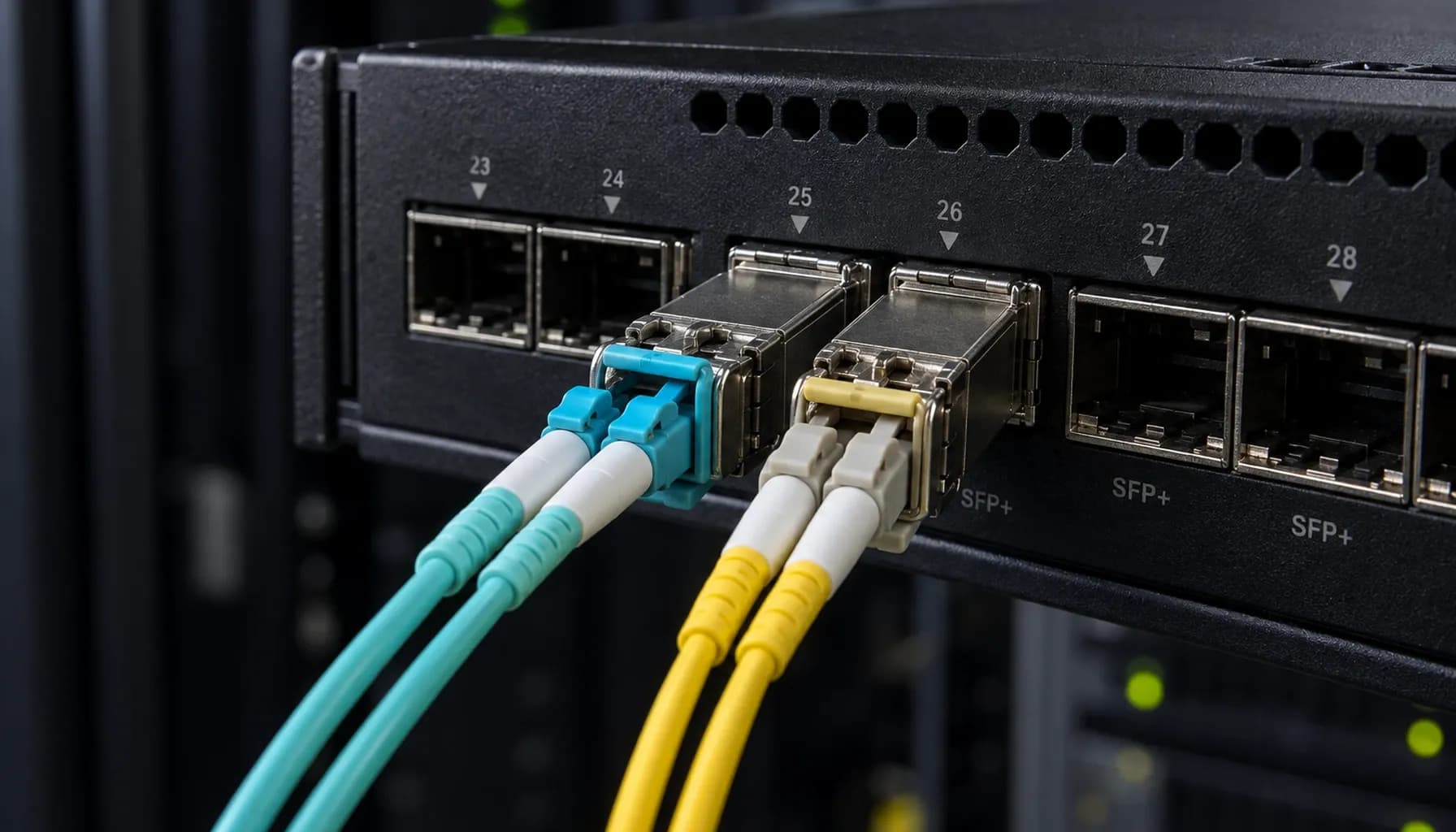
Strinex Spec Sheet: DAC vs AOC Hardware Comparison in ToR — Reach, Power, Latency & Vendor Benchmarks
In the realm of data center networking, the choice between Direct Attach Copper (DAC) and Active Optical Cables (AOC) for Top-of-Rack (ToR) connections is pivotal. This decision impacts not just performance but also cost, power consumption, and scalability. In this technical guide, we delve into the real-world deployment scenarios involving Cisco Catalyst/Nexus, Arista 7050X, and Juniper QFX switches to provide a comprehensive comparison of DAC and AOC technologies.
1. Reach and Distance Considerations
DAC vs AOC: Understanding the Limits
Direct Attach Copper (DAC) cables are typically limited to shorter distances, usually up to 10 meters for passive DAC and up to 15 meters for active DAC. This limitation is due to the inherent signal attenuation in copper cables. In contrast, Active Optical Cables (AOC) can extend up to 100 meters or more, depending on the fiber type and transceiver specifications.
- Passive DAC: Ideal for short-reach applications within a rack or between adjacent racks.
- Active DAC: Suitable for slightly longer distances, such as between racks in a data center row.
- AOC: Best for longer distances, such as between rows or even between data center buildings.
Key takeaway: DAC is best for short-reach applications, while AOC is preferred for longer distances and higher bandwidth requirements.
Real-World Deployment Scenarios
In a Cisco Nexus 9000 series deployment, passive DAC is often used for intra-rack connections due to its cost-effectiveness and low power consumption. However, for inter-rack connections, active DAC or AOC is preferred to ensure signal integrity over longer distances. Similarly, in Arista 7050X and Juniper QFX deployments, AOC is commonly used for connections that span multiple racks or rows.
2. Power Consumption and Heat Dissipation
DAC: Low Power, High Efficiency
DAC cables are passive and do not require additional power, making them highly efficient in terms of power consumption. This characteristic also means they generate less heat, which is a critical factor in high-density data center environments.
AOC: Power and Heat Considerations
AOC cables contain active components that require power, albeit minimal. The power consumption of AOC cables is typically in the range of 0.5 to 1.5 watts per cable, depending on the length and data rate. While this is negligible for a single cable, it can add up in high-density deployments.
- Cisco Catalyst/Nexus: AOC cables are often used in these switches for their flexibility and reach, but careful consideration is given to power and heat management in high-density environments.
- Arista 7050X: AOC cables are preferred for their ability to handle longer distances without significant power overhead.
- Juniper QFX: AOC cables are used for their reliability and performance, with power consumption managed through efficient switch design.
Key takeaway: DAC cables offer lower power consumption and heat generation, making them suitable for high-density environments, while AOC cables provide flexibility at the expense of slightly higher power usage.
3. Latency and Performance
DAC: Ultra-Low Latency
DAC cables offer ultra-low latency due to their direct copper connection. This makes them ideal for applications requiring high-speed, low-latency connections, such as high-frequency trading and real-time data processing.
AOC: Minimal Latency Impact
AOC cables introduce minimal latency due to the active components and optical conversion process. However, this latency is negligible for most applications and is often outweighed by the benefits of longer reach and higher bandwidth.
- Cisco Catalyst/Nexus: AOC cables are used in these switches for their performance and reliability, with latency being a non-issue for most applications.
- Arista 7050X: AOC cables are preferred for their ability to maintain high performance over longer distances.
- Juniper QFX: AOC cables are chosen for their reliability and performance, with latency being managed through efficient network design.
Key takeaway: DAC cables offer ultra-low latency, making them ideal for latency-sensitive applications, while AOC cables provide sufficient performance for most use cases.
4. Multi-Vendor Switch Compatibility and Configuration
DAC and AOC Compatibility
Both DAC and AOC cables are compatible with a wide range of switches from vendors such as Cisco, Arista, and Juniper. However, it is crucial to ensure that the cables meet the specific standards and specifications required by the switch manufacturer.
Configuration Examples
Cisco Catalyst/Nexus Configuration
1interface TenGigabitEthernet1/1/12 description ToR Connection - DAC3 speed 100004 duplex fullArista 7050X Configuration
1interface Ethernet12 description ToR Connection - AOC3 speed forced 10GJuniper QFX Configuration
1interfaces {2 et-0/0/1 {3 description "ToR Connection - DAC";4 unit 0 {5 family ethernet-switching {6 port-mode trunk;7 }8 }9 }10}Key takeaway: Both DAC and AOC cables are compatible with major switch vendors, but proper configuration and adherence to manufacturer specifications are essential for optimal performance.
5. Vendor Benchmarks and Recommendations
DAC vs AOC: Vendor Benchmarks
| Specification | DAC (Passive) | DAC (Active) | AOC |
|---|---|---|---|
| Reach | Up to 10m | Up to 15m | Up to 100m+ |
| Power Consumption | None | Low | Low |
| Latency | Ultra-Low | Low | Low |
| Cost | Low | Medium | High |
| Heat Generation | Low | Low | Low |
Recommendations
- Cisco Catalyst/Nexus: For intra-rack connections, use passive DAC. For inter-rack connections, use active DAC or AOC.
- Arista 7050X: Use AOC for its flexibility and performance, especially in environments where distance is a concern.
- Juniper QFX: Use AOC for reliability and performance, with DAC reserved for short-reach, cost-sensitive applications.
Key takeaway: The choice between DAC and AOC should be based on the specific requirements of the deployment, including reach, power, latency, and cost.
Conclusion
In summary, the decision between DAC and AOC for ToR connections is influenced by several factors, including reach, power consumption, latency, and cost. DAC cables offer a cost-effective, low-power solution for short-reach applications, while AOC cables provide the flexibility and performance needed for longer distances and higher bandwidths.
For more detailed insights into DAC and AOC technologies, refer to our comprehensive guide: Direct Attach Copper (DAC) vs Active Optical Cables (AOC) in ToR: Comprehensive Engineering & Architecture Guide: The Complete UAE Engineering Guide (2026). Additionally, explore our resources on fiber migration and cost engineering for a complete understanding of data center networking solutions: OS2 vs OM3/OM4 Migration Roadmap 2026: Future-Proofing UAE Fiber Without Forklift Upgrades and Capex vs Opex for Single-Mode OS2 and Multi-Mode OM3/OM4 Fiber Backbones: UAE Cost Engineering & ROI Benchmarks.