
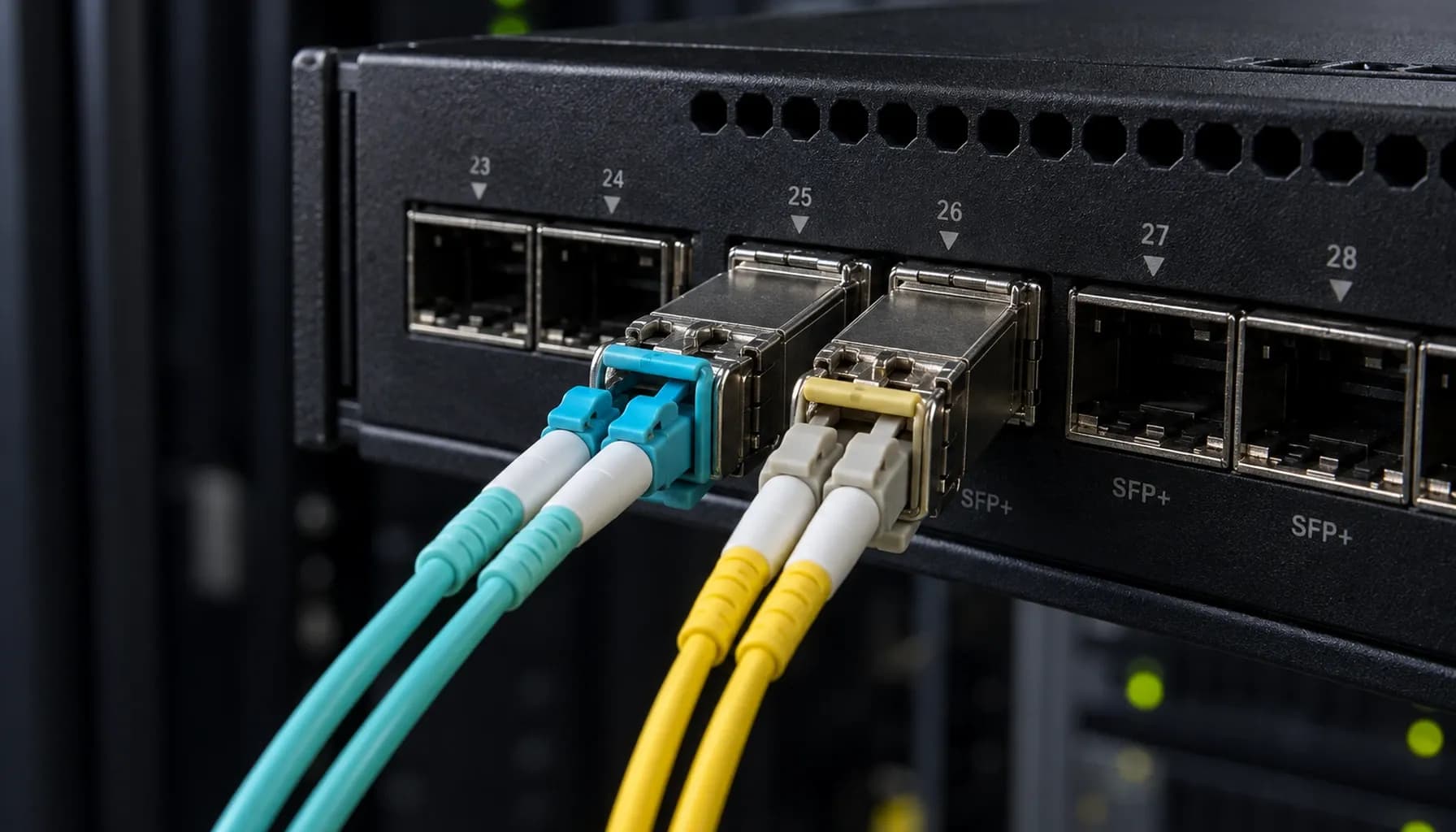
Direct Attach Copper (DAC) vs Active Optical Cables (AOC) in ToR: Comprehensive Engineering & Architecture Guide: The Complete UAE Engineering Guide (2026)
In the rapidly evolving landscape of data center networking in the UAE, selecting the right interconnect technology for Top-of-Rack (ToR) deployments is critical for performance, cost-efficiency, and scalability. This guide delves into the nuanced comparison between Direct Attach Copper (DAC) and Active Optical Cables (AOC) for ToR applications, focusing on real-world deployments with Cisco Catalyst/Nexus, Arista 7050X, and Juniper QFX switches.
1. DAC vs AOC: Core Differences and Use Cases
Understanding DAC and AOC
Direct Attach Copper (DAC) cables are passive, twin-axial copper cables with connectors on both ends, designed for short-reach interconnects within racks or between adjacent racks. They are commonly used for connections up to 10 meters, offering a cost-effective solution for high-speed data transmission.
Active Optical Cables (AOC), on the other hand, use fiber optic technology with integrated transceivers to extend the reach of connections up to 100 meters or more. AOCs are ideal for environments requiring longer reach, higher bandwidth, and immunity to electromagnetic interference (EMI).
Key Considerations for UAE Data Centers
In the UAE, where data centers are often located in densely packed urban areas or industrial zones with high temperatures and potential EMI, the choice between DAC and AOC can significantly impact network reliability and performance.
- DAC Use Cases: Ideal for short-reach, high-density connections within the same rack or adjacent racks. Commonly used in server-to-switch and switch-to-switch connections in environments where cost and power consumption are critical factors.
- AOC Use Cases: Best suited for longer distances, such as connections between racks or across data center aisles. AOCs are preferred in environments where EMI is a concern or where higher bandwidth is required.
Key takeaway: DAC is optimal for cost-sensitive, short-reach applications, while AOC is ideal for longer distances and environments with EMI concerns.
2. High-Density Comparison: DAC vs AOC Specifications, Standards, and Metrics
| Feature | DAC | AOC |
|---|---|---|
| **Cost** | Lower cost per meter | Higher cost per meter |
| **Reach** | Up to 10 meters | Up to 100 meters or more |
| **Bandwidth** | Up to 400 Gbps (depending on standard) | Up to 400 Gbps (depending on standard) |
| **Power Consumption** | Lower | Slightly higher due to integrated transceivers |
| **EMI Immunity** | Low | High |
| **Latency** | Lower | Slightly higher |
| **Standards** | SFP+, QSFP+, QSFP28, etc. | SFP+, QSFP+, QSFP28, etc. |
| **Typical Applications** | Server-to-switch, switch-to-switch within racks or adjacent racks | Switch-to-switch across racks, environments with EMI concerns |
| **Maintenance** | Easier due to simpler construction | More complex due to integrated transceivers |
| **Weight** | Heavier | Lighter |
Analysis
- Cost: DAC cables are generally more affordable, making them a preferred choice for short-reach applications.
- Reach and Bandwidth: AOC cables offer greater reach and are available in higher bandwidth options, making them suitable for longer distances and high-density environments.
- Power Consumption and EMI Immunity: AOCs consume slightly more power but provide better EMI immunity, which is crucial in environments with high electromagnetic interference.
Key takeaway: The choice between DAC and AOC should be based on the specific requirements of the deployment, including reach, bandwidth, and environmental factors.
3. Multi-Vendor Switch Compatibility and CLI Configuration
Cisco, Arista, and Juniper Compatibility
Both DAC and AOC cables are widely supported across major switch vendors, including Cisco, Arista, and Juniper. Below are example configurations for Cisco and Arista switches.
Cisco Catalyst/Nexus Configuration
1# Cisco Nexus Configuration Example2interface Ethernet1/13  description DAC Connection to Server4  switchport mode access5  switchport access vlan 106  speed 40G7  duplex full8  no shutdown9
10interface Ethernet1/211  description AOC Connection to Switch12  switchport mode trunk13  switchport trunk allowed vlan 10,20,3014  speed 100G15  duplex full16  no shutdown
Arista 7050X Configuration
1# Arista Configuration Example2interface Ethernet13  description DAC Connection to Server4  switchport mode access5  switchport access vlan 106  speed forced 40G7  duplex full8  no shutdown9
10interface Ethernet211  description AOC Connection to Switch12  switchport mode trunk13  switchport trunk allowed vlan 10,20,3014  speed forced 100G15  duplex full16  no shutdown
Juniper QFX Configuration
1# Juniper QFX Configuration Example2interfaces {3 et-0/0/1 {4 description DAC Connection to Server;5 unit 0 {6 family ethernet-switching {7 port-mode access;8 vlan {9 members 10;10 }11 }12 }13 speed 40g;14 link-mode full-duplex;15 }16 et-0/0/2 {17 description AOC Connection to Switch;18 unit 0 {19 family ethernet-switching {20 port-mode trunk;21 vlan {22 members [10 20 30];23 }24 }25 }26 speed 100g;27 link-mode full-duplex;28 }29}Key takeaway: DAC and AOC cables are compatible with major switch vendors, but proper configuration is essential to ensure optimal performance.
4. Real-World Deployment Considerations in the UAE
Environmental Factors
In the UAE, data centers often face challenges such as high temperatures, humidity, and power surges. When selecting DAC or AOC cables, consider the following:
- Temperature and Humidity: DAC cables are more susceptible to temperature fluctuations and humidity, which can affect their performance. AOCs, with their fiber optic construction, are more resilient in such environments.
- Power Surges: AOCs, with their integrated transceivers, may offer better protection against power surges compared to DAC cables.
OS2 vs OM3/OM4 Migration Roadmap 2026: Future-Proofing UAE Fiber Without Forklift Upgrades
When deploying AOCs, it's crucial to align with the migration roadmap for fiber types. This article provides insights into future-proofing fiber infrastructure in the UAE.
Capex vs Opex for Single-Mode OS2 and Multi-Mode OM3/OM4 Fiber Backbones: UAE Cost Engineering & ROI Benchmarks
Understanding the cost implications of DAC and AOC deployments is vital. This article offers benchmarks for cost engineering and ROI analysis in the UAE context.
OS2 vs OM3/OM4 in Dubai Industrial Estates: Specifying Fiber for Heat, Humidity & Power-Surge Compliance
For deployments in industrial areas, this article provides guidance on selecting the right fiber types for compliance with environmental challenges.
5. Troubleshooting and Maintenance
Strinex Engineer's Handbook: Troubleshooting Single-Mode (OS2) vs Multi-Mode (OM3/OM4) - From DOM Alarms to OTDR Event Analysis on Cisco, Arista & Juniper
Effective troubleshooting is essential for maintaining network integrity. This handbook provides comprehensive guidance on troubleshooting DAC and AOC connections on Cisco, Arista, and Juniper switches.
Key Maintenance Tips
- Regular Inspections: Regularly inspect connectors for dust and damage.
- Proper Storage: Store cables in a controlled environment to prevent degradation.
- Documentation: Maintain detailed documentation of cable types, lengths, and configurations.
Key takeaway: Regular maintenance and proper troubleshooting are crucial for ensuring the longevity and reliability of DAC and AOC deployments.
Conclusion
Selecting between DAC and AOC for ToR deployments in the UAE requires a thorough understanding of the specific needs of the data center environment. By considering factors such as reach, bandwidth, environmental conditions, and cost, network engineers can make informed decisions that ensure optimal performance and reliability. With the right configuration and maintenance, both DAC and AOC can provide robust solutions for high-speed data transmission in modern data centers.
---
This guide aims to equip UAE-based engineers with the knowledge needed to make strategic decisions in their data center interconnect strategies. By leveraging the insights provided, you can enhance the efficiency and resilience of your network infrastructure.