
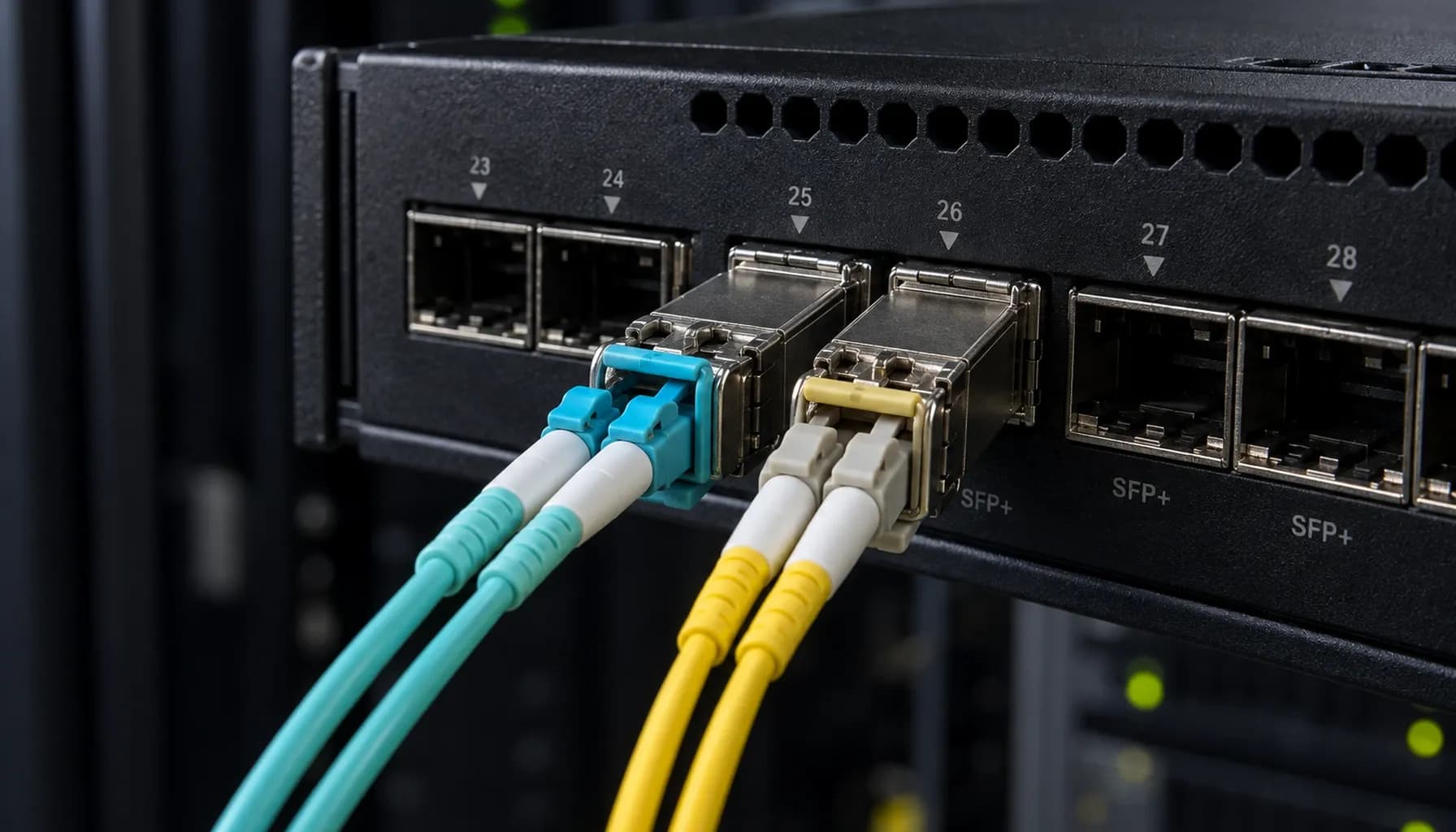
Phased 100G-to-400G ToR Upgrade Path: QSFP-DD Breakout, Native 400G Migration & Lane-Mapping Checkpoints for UAE Data Centers (2026)
Introduction: The 100G to 400G Transition Challenge
As UAE data centers prepare for the 2026 technology refresh cycle, the transition from 100G to 400G Top-of-Rack (ToR) switches presents a complex engineering challenge. This migration requires a phased approach to ensure minimal disruption, optimal performance, and cost-efficiency. A critical decision point in this upgrade path is the choice between Direct Attach Copper (DAC) and Active Optical Cables (AOC). This article provides a detailed roadmap for this transition, focusing on QSFP-DD breakout strategies, native 400G migration, and lane-mapping considerations, while comparing DAC and AOC solutions.
---
1. QSFP-DD Breakout Strategies: DAC vs AOC
Understanding Breakout Options
The QSFP-DD form factor allows for breakout configurations, enabling a single 400G port to be split into multiple lower-speed ports (e.g., 4x100G). This is particularly useful for gradual upgrades, allowing data centers to leverage existing 100G infrastructure while transitioning to 400G.
DAC Breakout Solutions
DAC cables offer a cost-effective, low-latency solution for short-reach applications (typically up to 3 meters). They are ideal for intra-rack connections and provide a straightforward breakout option.
- Advantages:
- Lower power consumption
- Lower latency
- Cost-effective for short distances
- Considerations:
- Limited to short distances
- Bulkier and less flexible than AOC
AOC Breakout Solutions
AOC cables are suitable for longer distances (up to 30 meters) and offer more flexibility in terms of cable management. They are ideal for inter-rack connections and provide a cleaner cable management solution.
- Advantages:
- Longer reach
- More flexible and easier to manage
- Lower weight
- Considerations:
- Higher power consumption
- Slightly higher latency
- Higher cost
Comparison Table: DAC vs AOC for QSFP-DD Breakout
| Feature | DAC (Direct Attach Copper) | AOC (Active Optical Cable) |
|---|---|---|
| **Reach** | Up to 3 meters | Up to 30 meters |
| **Power Consumption** | Lower | Higher |
| **Latency** | Lower | Slightly higher |
| **Cost** | Lower | Higher |
| **Flexibility** | Less flexible, bulkier | More flexible, easier to manage |
| **Ideal Use Case** | Intra-rack connections, short distances | Inter-rack connections, longer distances |
| **Standards** | IEEE 802.3bj, InfiniBand, Fibre Channel | IEEE 802.3bm, InfiniBand, Fibre Channel |
Key takeaway: DAC is ideal for cost-effective, short-reach applications, while AOC offers flexibility and longer reach for inter-rack connections.
---
2. Native 400G Migration: Switch Compatibility and Configuration
Multi-Vendor Switch Compatibility
When migrating to native 400G, ensuring compatibility across different switch vendors is crucial. Below are configuration examples for Cisco, Arista, and Juniper switches.
Cisco Catalyst/Nexus Configuration
1interface Ethernet1/12 description 400G Uplink to Core3 no shutdown4 speed 400G5 media-type 400G-SR8Arista 7050X Configuration
1interface Ethernet12 description 400G Uplink to Core3 no shutdown4 speed forced 400G5 transceiver 400G-SR8Juniper QFX Configuration
1interfaces et-0/0/1 {2 description "400G Uplink to Core";3 unit 0 {4 family ethernet-switching {5 port-mode trunk;6 }7 }8 speed 400g;9 link-mode active;10}Vendor-Specific Considerations
- Cisco: Supports a wide range of 400G transceivers, including SR8, DR4, and LR4.
- Arista: Known for its high-density 400G solutions, with support for SR8 and DR4 transceivers.
- Juniper: Offers robust 400G support with a focus on high-performance computing and data center interconnect.
Key takeaway: Multi-vendor compatibility is achievable with careful transceiver selection and configuration.
---
3. Lane-Mapping Checkpoints for 400G Migration
Understanding Lane Mapping
Lane mapping is critical for ensuring data integrity and performance during the migration. 400G links use 8 lanes of 50G each, and proper mapping is essential for error-free operation.
Lane-Mapping Best Practices
- Verify Transceiver Compatibility:
- Ensure that the 400G transceivers support the required lane mapping.
- Check for compatibility with the switch's firmware and hardware.
- Check for FEC (Forward Error Correction):
- Ensure that FEC is enabled and correctly configured.
- Refer to Why Your 100G DAC vs AOC Link Flaps: FEC Mismatch, DOM Alarms & Symbol Error Diagnostics (2026) for more details.
- Monitor DOM (Digital Optical Monitoring):
- Use DOM to monitor the health of the optical links.
- Set up alarms for any anomalies.
- Validate Signal Integrity:
- Use diagnostic tools to verify signal integrity across all lanes.
- Ensure that there are no symbol errors or other issues.
Lane-Mapping Example
1# Example of lane mapping configuration on Cisco Nexus2interface Ethernet1/13 transceiver 400G-SR84 lane-mapping 1-8Key takeaway: Proper lane mapping is essential for ensuring data integrity and performance during the 400G migration.
---
4. Procurement and Environmental Considerations
Procurement Framework
When planning the 100G to 400G migration, it's important to consider the procurement of DAC and AOC cables. Factors such as price points, failure replacement costs, and local stock availability in Dubai should be taken into account.
For a detailed procurement framework, refer to Procurement Framework 2026: 100G DAC vs AOC Price Points, Failure Replacement Cost & Local Dubai Stock Sourcing.
Environmental Qualification
Environmental factors such as shock and salt mist can affect the performance and reliability of DAC and AOC cables. It's important to ensure that the cables meet the necessary environmental standards.
For more information on environmental qualification, refer to Environmental Qualification for 100G DAC & AOC Links: IEC 60068 Shock & Salt Mist, Telcordia GR-468 Survival Testing.
Key takeaway: Proper procurement and environmental qualification are crucial for the success of the migration.
---
Conclusion: A Phased, Multi-Faceted Approach
The transition from 100G to 400G ToR switches is a complex process that requires careful planning and execution. By leveraging QSFP-DD breakout strategies, ensuring multi-vendor compatibility, and adhering to lane-mapping best practices, UAE data centers can achieve a smooth and efficient migration. Additionally, considering DAC and AOC options, procurement frameworks, and environmental factors will further ensure the success of the upgrade.
As you embark on this journey, remember that the key to a successful migration is a phased, multi-faceted approach that balances performance, cost, and reliability.