
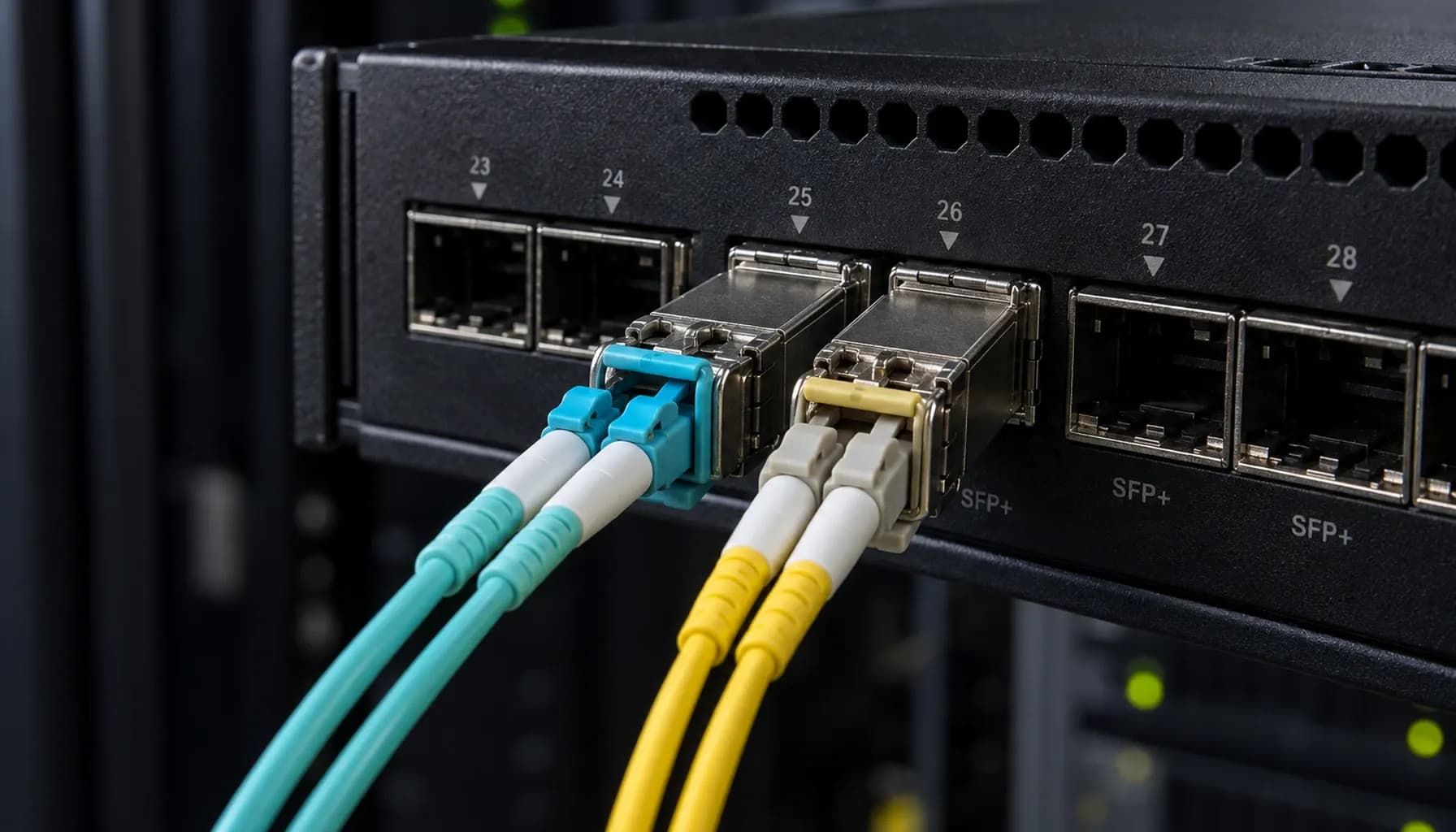
Procurement Framework 2026: 100G DAC vs AOC Price Points, Failure Replacement Cost & Local Dubai Stock Sourcing
Introduction: The 100G Connectivity Dilemma in ToR Architectures
In modern data center architectures, especially within the UAE's rapidly evolving digital landscape, the choice between 100G Direct Attach Copper (DAC) and Active Optical Cables (AOC) for Top-of-Rack (ToR) connectivity is pivotal. This decision impacts not just immediate costs but also long-term operational efficiency, maintenance overhead, and scalability. This article delves into a detailed cost analysis, multi-vendor compatibility, and local Dubai stock availability to equip network architects and procurement officers with actionable insights for the 2026 procurement cycle.
H2: Cost Analysis: 100G DAC vs AOC in UAE Data Centers
Upfront Costs and Price Points
When evaluating the cost of 100G DAC and AOC solutions, the initial price point is a significant factor.
- 100G DAC Cables: These are generally more cost-effective, with prices ranging from AED 300 to AED 800 per cable, depending on the length and quality. DACs are favored for short-reach applications (typically up to 5 meters) due to their lower cost and lower power consumption.
- 100G AOC Cables: AOC cables, while more expensive, offer greater flexibility and longer reach. Prices for AOCs start from AED 1,200 and can go up to AED 2,500 for longer lengths (up to 30 meters). AOCs are ideal for environments where signal integrity and longer distances are required.
Key takeaway: For short-reach applications (up to 5m), 100G DACs offer a more economical solution, while AOCs are better suited for longer distances and environments requiring higher signal integrity.
Failure Replacement Costs
The cost of failure and replacement is another critical aspect. DAC cables, being simpler in design, have a lower failure rate but are more susceptible to physical damage due to their rigid structure. Conversely, AOCs, with their fiber-optic components, are more fragile but offer better resistance to electromagnetic interference (EMI).
- DAC Replacement: The average cost of replacing a failed DAC cable is relatively low, averaging around AED 500, including labor. However, the downtime can be significant if spares are not readily available.
- AOC Replacement: AOCs have a higher replacement cost, averaging around AED 1,500, due to the complexity of the fiber-optic components. However, their failure rate is generally lower, and they often come with longer warranties.
Key takeaway: While DACs have lower replacement costs, AOCs offer better reliability and longer warranties, which can offset the higher upfront cost over time.
Local Dubai Stock Sourcing
Availability of stock in local Dubai warehouses is crucial for minimizing downtime. Both DAC and AOC cables are widely available in the UAE, but the lead times can vary.
- DAC Cables: Due to their popularity and lower cost, DAC cables are often stocked in larger quantities. Local suppliers typically have a ready supply, with lead times of 1-2 days for standard lengths.
- AOC Cables: AOCs, being more specialized, may have longer lead times, especially for non-standard lengths. However, major suppliers in Dubai maintain a steady stock of common configurations, with lead times of 3-5 days.
Key takeaway: For critical deployments, it is advisable to source DACs and AOCs from local suppliers with proven track records to ensure quick availability and minimize downtime.
H2: High-Density Comparison Table: 100G DAC vs AOC Specifications
| **Specification** | **100G DAC** | **100G AOC** |
|---|---|---|
| **Data Rate** | 100 Gbps | 100 Gbps |
| **Reach** | Up to 5 meters | Up to 30 meters |
| **Power Consumption** | Low (0.1W per cable) | Moderate (0.5W per cable) |
| **Latency** | Ultra-low (1-2 ns) | Low (10-15 ns) |
| **EMI Resistance** | Low | High |
| **Cost per Cable** | AED 300 - AED 800 | AED 1,200 - AED 2,500 |
| **Standards Compliance** | IEEE 802.3bj, SFF-8402 | IEEE 802.3bm, SFF-8636 |
| **Typical Applications** | Short-reach, high-density environments, cost-sensitive deployments | Long-reach, high-signal-integrity environments, EMI-sensitive deployments |
| **Vendor Compatibility** | Cisco, Arista, Juniper | Cisco, Arista, Juniper |
Key takeaway: This table underscores the trade-offs between DAC and AOC cables, helping in making informed decisions based on specific deployment requirements.
H2: Multi-Vendor Switch Compatibility and CLI Configuration
Cisco, Arista, and Juniper Compatibility
Both 100G DAC and AOC cables are supported across major switch vendors, including Cisco, Arista, and Juniper. Below are sample CLI configurations for each vendor to ensure seamless integration.
Cisco Nexus Configuration
1interface Ethernet1/12 description 100G DAC Connection3 speed 100g4 duplex full5 no shutdownArista Configuration
1interface Ethernet12 description 100G AOC Connection3 speed forced 1000004 duplex full5 no shutdownJuniper QFX Configuration
1interfaces et-0/0/12 description 100G DAC Connection3 unit 04 family ethernet-switching5 port-mode trunk6 no-shutdownKey takeaway: Proper CLI configuration is essential for ensuring compatibility and optimal performance across different switch platforms.
H2: Deployment Considerations and Best Practices
Installation Standards and Bend Radius
When deploying 100G DAC and AOC cables, adhering to installation standards is crucial. For DAC cables, maintaining a minimum bend radius of 1.5 inches is recommended to prevent signal loss. AOCs, with their fiber-optic components, require careful handling to avoid microbending and physical damage.
Bring-Up Checklist
- Pre-Installation Inspection: Verify cable integrity and connectors.
- Routing: Ensure proper routing to maintain bend radius and avoid interference.
- Connection: Securely connect cables to switches and servers.
- Post-Installation Testing: Conduct link tests to confirm signal integrity and performance.
Key takeaway: Following a comprehensive bring-up checklist ensures reliable and efficient deployment of 100G DAC and AOC cables.
Environmental Qualification for 100G DAC & AOC Links: IEC 60068 Shock & Salt Mist, Telcordia GR-468 Survival Testing
Understanding the environmental qualifications of DAC and AOC cables is essential for deployments in challenging environments. Read more about the IEC 60068 and Telcordia GR-468 standards.
Why Your 100G DAC vs AOC Link Flaps: FEC Mismatch, DOM Alarms & Symbol Error Diagnostics (2026)
Link flaps can be a common issue in 100G deployments. Understanding the root causes, such as FEC mismatch and DOM alarms, is critical for troubleshooting. Read more.
Deploying 100G DAC vs AOC in UAE Data Centers: Installation Standards, Bend Radius & Bring-Up Checklist
For detailed insights into the deployment of 100G DAC and AOC cables in UAE data centers, read our comprehensive guide.
Conclusion
The choice between 100G DAC and AOC cables is not one-size-fits-all. It requires a nuanced understanding of cost, reliability, and specific deployment requirements. By leveraging local Dubai stock sourcing and adhering to best practices, network architects can make informed decisions that align with their operational and financial objectives.
Final Key Takeaway: As we approach 2026, the decision between DAC and AOC should be driven by a comprehensive evaluation of cost, reliability, and long-term operational goals, ensuring that the chosen solution meets the dynamic demands of modern data center environments.