
DEWA Shams Dubai Solar Net Metering: DRRG Compliance & Smart Metering Engineering Guide (2026)
The Engineering Problem: Solar Generation Must Be Measurable, Bidirectional, and Auditable
A Dubai rooftop photovoltaic system connected under DEWA Shams cannot be treated as an isolated inverter installation. The design must demonstrate four things: the PV system operates within DEWA’s applicable Distributed Resource Rules and Guidelines (DRRG), the revenue-grade meter records imported and exported energy correctly, inverter and meter telemetry is available for operational analysis, and the communications path remains reliable through high-temperature, electrically noisy Gulf conditions.
The critical boundary is that solar SCADA telemetry is not a substitute for utility metering or DRRG approval. SCADA supports engineering visibility, alarms, performance reporting, and fault isolation; the approved meter and utility records provide the commercial and compliance evidence. A robust architecture therefore separates protection, revenue metering, control, and observability rather than forcing every function through one RS485 cable or one industrial switch.
A typical deployment has four layers:
- PV plant: Strings, combiners, inverters, and inverter-integrated or standalone protection.
- Site controller: Data loggers, Modbus RTU masters, protocol gateways, and local historians.
- Network fabric: Industrial Ethernet switches carrying Modbus TCP, MQTT, HTTPS, and management traffic.
- Utility and enterprise systems: Approved bidirectional meter data, DERMS or utility interfaces, billing systems, and operations dashboards.
This separation reduces a common failure mode in Dubai installations: using a low-cost data logger as the permanent record of export energy, then discovering that its clock, scaling, or communication logs do not satisfy the utility’s acceptance requirements.
Reference Architecture for DEWA Shams Net Metering
The preferred path is inverter RS485 Modbus RTU to an isolated gateway, followed by MQTT or Modbus TCP over a managed switch to the site historian. The utility meter remains electrically and contractually independent, with any customer-side telemetry obtained through an approved interface.
1PV Inverters2 │ RS485 / Modbus RTU3 ▼4Isolated Modbus Gateway ── Local Historian / HMI5 │ Modbus TCP or MQTT over Ethernet6 ▼7Managed Industrial Switch ── Firewall / DMZ ── DERMS / Operations8 │9 └── Approved utility revenue meter interfaceThe gateway should maintain the inverter register map, scale engineering values, apply timestamps, and expose only required tags. The switch should not be asked to understand Modbus register semantics; it transports frames, provides resilience, and protects the control plane.
For larger sites, redundant gateways or dual-homed switching may be justified. For a residential or small commercial installation, a single hardened gateway with local buffering is often more reliable than an unnecessarily complex topology. The deciding factors are outage visibility, telemetry retention, utility interface requirements, and the expected engineering support burden.
DRRG Compliance Is More Than Connecting a Solar Inverter
Before procurement, the designer should identify the applicable DEWA connection category, approved equipment list, voltage level, anti-islanding requirement, protection settings, metering arrangement, and commissioning process. The exact DEWA Shams and DRRG documents must be checked against the project’s latest revision; an approval decision should never be inferred from the fact that an inverter supports Modbus.
Compliance usually spans several technical domains:
- Connection and protection: Correct voltage, frequency, grounding, fault-current contribution, anti-islanding, and loss-of-mains behavior.
- Metering: Approved meter class, bidirectional energy measurement, time-of-use or tariff configuration, event logs, and secure data access.
- Power quality: Harmonics, voltage flicker, rapid voltage changes, DC injection limits where applicable, and power-factor requirements.
- Operations: Remote indication, outage notification, performance data, fault codes, and controlled reconnection procedures.
- Cybersecurity: Network segmentation, authenticated access, controlled firmware changes, and protection of operational technology.
A frequent design error is to assume that an inverter’s RS485 port is a utility-grade telemetry interface. It is normally an equipment maintenance interface. The gateway must be tested against the actual inverter firmware and register version, while the meter interface must be approved independently for utility data exchange.
Key takeaway: DEWA Shams approval is a system-level decision covering protection, approved metering, power quality, and evidence. SCADA connectivity supports compliance but does not replace it.
High-Density Comparison: DEWA Shams, Metering, SCADA, and Network Design
| Design area | DEWA/utility-facing requirement | SCADA/telemetry requirement | Recommended engineering evidence |
|---|---|---|---|
| Energy measurement | Approved bidirectional revenue meter; correct import/export direction | Inverter readings are operational estimates unless validated | Meter certificate, configuration record, witnessed test |
| Compliance basis | Current DEWA connection rules and DRRG category | Equipment-specific register map and alarm definitions | Signed design package and commissioning checklist |
| Communications | Defined utility interface where required | Modbus RTU/TCP, MQTT, or HTTPS as appropriate | Point list, data dictionary, interface test report |
| Protection | Anti-islanding, fault interruption, grounding, and restoration controls | Separate protection relays and inverter control contacts | Protection coordination study and trip records |
| Data integrity | Time-stamped, auditable utility records | Local buffering and event sequence | NTP source, logs, alarm history, configuration backups |
| RS485 | Utility meter interface must follow approved wiring rules | Isolated RS485 for inverter polling | Insulation test, wiring diagram, bus measurement |
| Network security | Controlled utility access and least privilege | VLANs, ACLs, management isolation | Security baseline and access review |
| Environmental duty | Equipment suitable for the installation location | Industrial temperature range, reliable PSU and optics | Product certificates and site thermal survey |
| Vendor interoperability | Project-specific acceptance | Stable register maps across mixed inverter fleets | Vendor matrix and regression test |
| Acceptance | Meter and protection witnessed testing | End-to-end telemetry verification | SCADA screenshots, trend exports, alarm test |
The table highlights an important distinction: compliance evidence must be reproducible. A dashboard showing “12.4 kW” is not sufficient if the source register, scaling factor, timestamp, and inverter operating mode are not documented.
RS485 Modbus Wiring Best Practices for Solar Plants
RS485 is a physical layer, not a protocol. Modbus RTU defines the frame format, while the application defines addresses, register maps, baud rate, parity, and polling behavior. In a multi-inverter field, the bus should remain electrically simple and deterministically terminated.
Field wiring rules
- Use twisted-pair shielded cable, preferably with a characteristic impedance around 120 ohms. Shield continuity should be verified; shield grounding follows the site’s approved lightning-protection and EMC design.
- Connect A-to-A and B-to-B at every device. Some vendors use D+/D− or non-inverted naming; confirm the manufacturer’s manual rather than relying on labels.
- Avoid shared cable routes with high-current AC feeders where practical. Crossings should be at right angles.
- Install a fuse or resettable protection device on each transceiver supply, and use surge protection designed for the cable and grounding arrangement.
- Keep the RS485 trunk away from switchgear terminations and long parallel runs of mains cabling.
- Use a dedicated isolated RS485 transceiver at the gateway. Galvanic isolation prevents ground-potential differences from corrupting frames or damaging electronics.
- Provide local access for insertion and removal without disturbing adjacent terminators.
Terminate the bus at the two physical ends only. A termination resistor is normally selected according to the transceiver and cable specification, commonly around 120 ohms. Do not fit termination at every inverter “because it is available.” With three or more devices, star connections can create unbalanced stubs and reflections; daisy-chain topology is generally more predictable.
Polling and register discipline
Use unique Modbus slave addresses within a defined range, maintain a master poll schedule, and record every failed transaction with the device address, function code, exception code, timestamp, and retry count. Avoid saturating the inverter bus. A one-second poll interval is often excessive for a large inverter fleet.
Register mapping should distinguish raw registers from engineering values. For example, a raw power value may require a decimal scale and a signed interpretation. Test at zero output, rated output, and several intermediate operating points. Loss of communications should create an alarm with a clear timeout threshold; it should not silently display the last value as current.
Key takeaway: Isolated transceivers, correct end termination, controlled polling, and documented scaling are more important than the number of Modbus features advertised by a gateway.
Multi-Vendor Switch and CLI Configuration
The following is an operational baseline for industrial Ethernet transport. Interface names, feature support, and credential procedures must be validated against the installed software train.
1# Cisco Catalyst IOS XE example2configure terminal3 vlan 104 name SOLAR_SCADA5 state active6 vlan 207 name SOLAR_DMZ8 state active9 interface range GigabitEthernet1/0/1-410 description RS485_GATEWAY_UPLINK11 switchport access vlan 1012 spanning-tree portfast13 spanning-tree bpduguard enable14 interface GigabitEthernet1/0/2415 description SOLAR_DMZ_UPLINK16 switchport mode trunk17 switchport trunk allowed vlan 10,2018 no shutdown19 ip routing20 interface Vlan1021 ip address 10.10.10.2 255.255.255.022 no shutdown23 interface Vlan2024 ip address 10.10.20.2 255.255.255.025 no shutdown26 ip access-list extended SOLAR_DMZ27 permit tcp host 10.10.10.10 any eq 50228 permit tcp host 10.10.10.10 any eq 188329 permit udp host 10.10.10.10 any eq 188330 interface Vlan1031 ip access-group SOLAR_DMZ in32end1# Arista EOS example on 7050X2configure terminal3 vlan 104 vlan 205 interface Ethernet16 description RS485_GATEWAY7 no switchport8 ip address 10.10.10.2/249 interface Ethernet2410 description SOLAR_DMZ_UPLINK11 no switchport12 ip address 10.10.20.2/2413 ip routing14end1# Juniper Junos example on QFX2set interfaces ethernet ae1 unit 0 family inet address 10.10.10.2/243set interfaces ethernet ae24 unit 0 family inet address 10.10.20.2/244set vlans SOLAR_SCADA vlan-id 105set vlans SOLAR_DMZ vlan-id 206set protocols bgp group SOLAR_GATEWAY local-address 10.10.10.2In production, use a routed design where the platform and security model support it, or a VLAN design with explicit trunks and access ports. Restrict management access through a dedicated management VRF, TACACS or RADIUS where available, and SSH. Disable unused ports or place them in a quarantine VLAN. The gateway should not receive unrestricted access to the enterprise network.
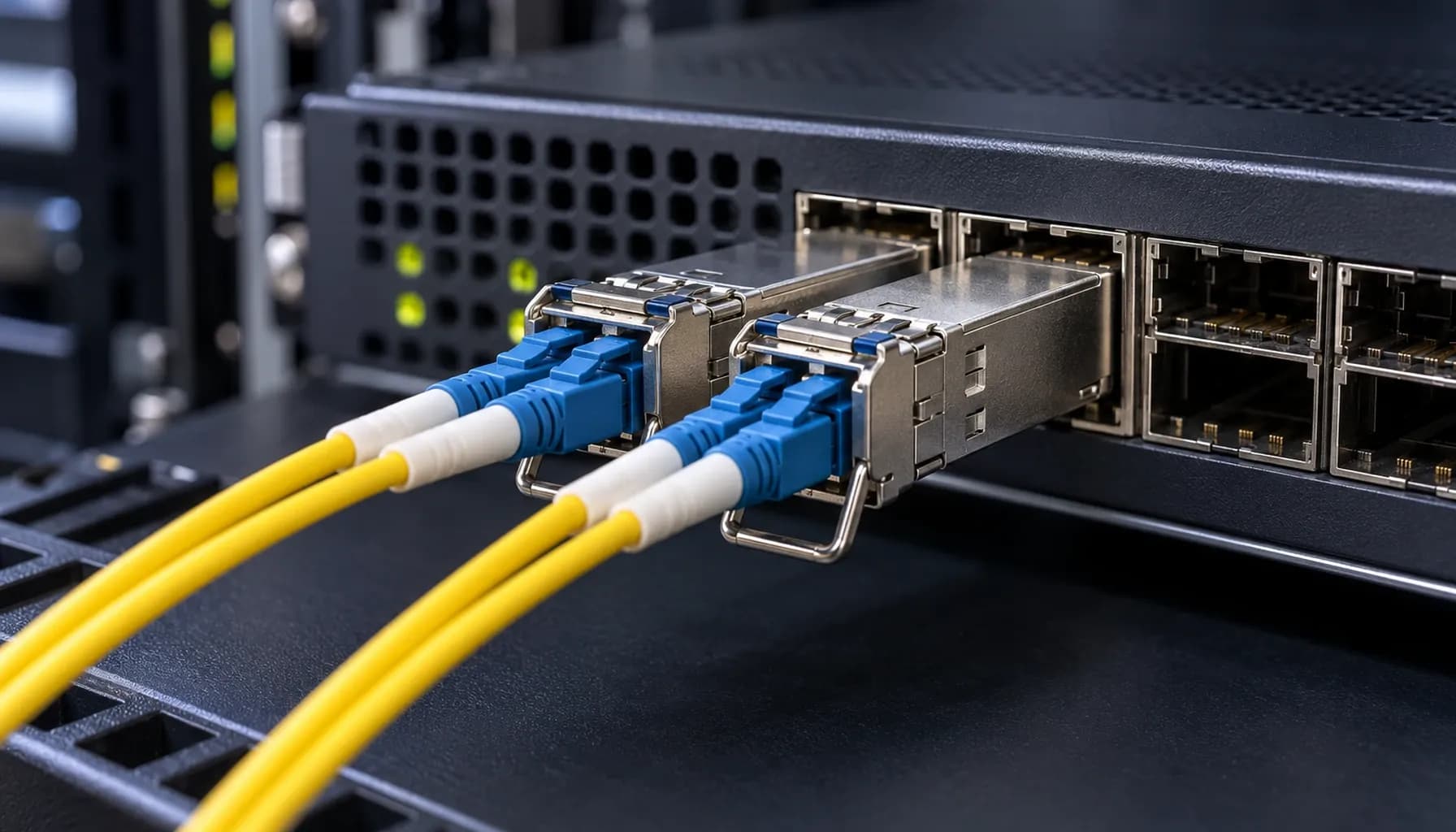
For 100G uplinks, optical compatibility must be proven against the exact switch ASIC, optics, and breakout configuration. When evaluating future 1.6T procurement, note that the 1.6T Is Still in Development: Reading the P802.3dj July 2026 Completion Date Before You Buy Optics (2026) standard remains a planning consideration rather than a general availability assumption. Separately, the End-of-Sale Countdown for 100G Modules: Last Ship Date, Routine Failure Analysis and Support Windows (2026) is directly relevant to lifecycle risk.
Gulf deployments also require disciplined thermal and optical validation. The Choosing a Temperature Grade for Gulf Deployments: C-Temp, E-Temp and I-Temp Compared for 100G (2026) comparison should be applied to the switch, optics, cable plant, and enclosure—not just the transceiver label.
Commissioning and Fault-Proofing
Commissioning should proceed from the meter outward. First verify meter configuration, multiplier, import/export channels, clock, tariff schedule, and communications. Then confirm inverter register values against a calibrated reference instrument at multiple power levels.
The test plan should intentionally verify negative network conditions: unplug the RS485 gateway, disconnect the uplink, reboot the gateway, corrupt a register value, and simulate loss of time synchronization. The expected alarm, retry behavior, local buffering, and restoration sequence must all be documented.
For optical links, distinguish link failure from physical-layer errors. CRC errors, symbol errors, and transceiver diagnostics should be reviewed separately. This is especially important when a remote site reports intermittent telemetry loss: the fault may be in the switch ASIC, optic, patch cord, connector, or environmental path. The Stomped CRC vs Invalid CRC on 100G Ports: Separating Switch ASIC Faults from Cable and Connector Faults (2026) diagnostic guide provides a useful framework for separating those domains.
Retain as-built VLAN and ACL configurations, firmware versions, optical inventories, Modbus maps, protection settings, meter certificates, alarm definitions, and test evidence. A site that cannot reconstruct its configuration during a DRRG audit is not operationally complete.
Frequently Asked Questions
Does RS485 Modbus connectivity automatically satisfy DEWA Shams net-metering compliance?
No. Modbus connectivity supports telemetry, commissioning, and performance analysis. DEWA Shams net-metering compliance still depends on the applicable DRRG category, approved protection, power-quality performance, meter approval, and witnessed testing. An inverter or gateway being Modbus-compatible does not make it a utility-approved measurement or revenue device.
Can the same smart meter be used for both DEWA settlement and solar SCADA?
Sometimes, but only if the meter model, configuration, data interface, and cybersecurity controls are explicitly approved for that use. Many sites benefit from electrically independent paths: the revenue meter for settlement and a gateway for inverter telemetry. This separation prevents maintenance activity on the SCADA network from affecting the commercial measurement path.
Is a Modbus TCP gateway required for every Dubai solar installation?
Not always. A small site may use a local controller with serial logging and a secure uplink. A gateway becomes more valuable when multiple inverter protocols must be normalized, data must be buffered, or the solar controller must communicate over MQTT, REST, or another enterprise interface. The requirement should be driven by availability, auditability, and integration complexity.
What is the most common RS485 failure in a multi-inverter solar plant?
The most common issue is improper termination combined with long or unbalanced cable runs. Incorrect A/B polarity, missing isolation, inconsistent baud rates, duplicate addresses, and excessive polling are also frequent. The remedy is a measured design: verify the wiring diagram, measure the bus, document the termination locations, and test each inverter individually before enabling the full poll schedule.
Should Cisco, Arista, or Juniper switches be selected based on solar telemetry requirements?
The brand is less important than verified behavior. Confirm VLAN support, routing, management security, environmental ratings, optical compatibility, local fault visibility, and the vendor’s support lifecycle. Cisco Catalyst and Nexus, Arista 7050X, and Juniper QFX platforms can all serve suitable designs, but the exact software release and hardware bill of materials must be tested together.
Key Takeaways
- Confirm the current DEWA Shams connection category, DRRG requirements, protection, and approved metering path before ordering equipment.
- Treat the revenue meter as the commercial source of truth; treat solar SCADA as an operational and engineering data source.
- Standardize inverter register maps, scaling factors, timestamps, alarm behavior, and failover tests across the site.
- Use isolated RS485 transceivers, correct termination, protected supplies, controlled polling, and documented cable drawings.
- Validate switch security, thermal duty, optics, firmware, and support lifecycle against the actual Gulf deployment environment.
Conclusion
Specify and procure the complete DEWA Shams metering and telemetry solution with validated compliance, interoperability, and lifecycle evidence through the Strinex catalogue.