
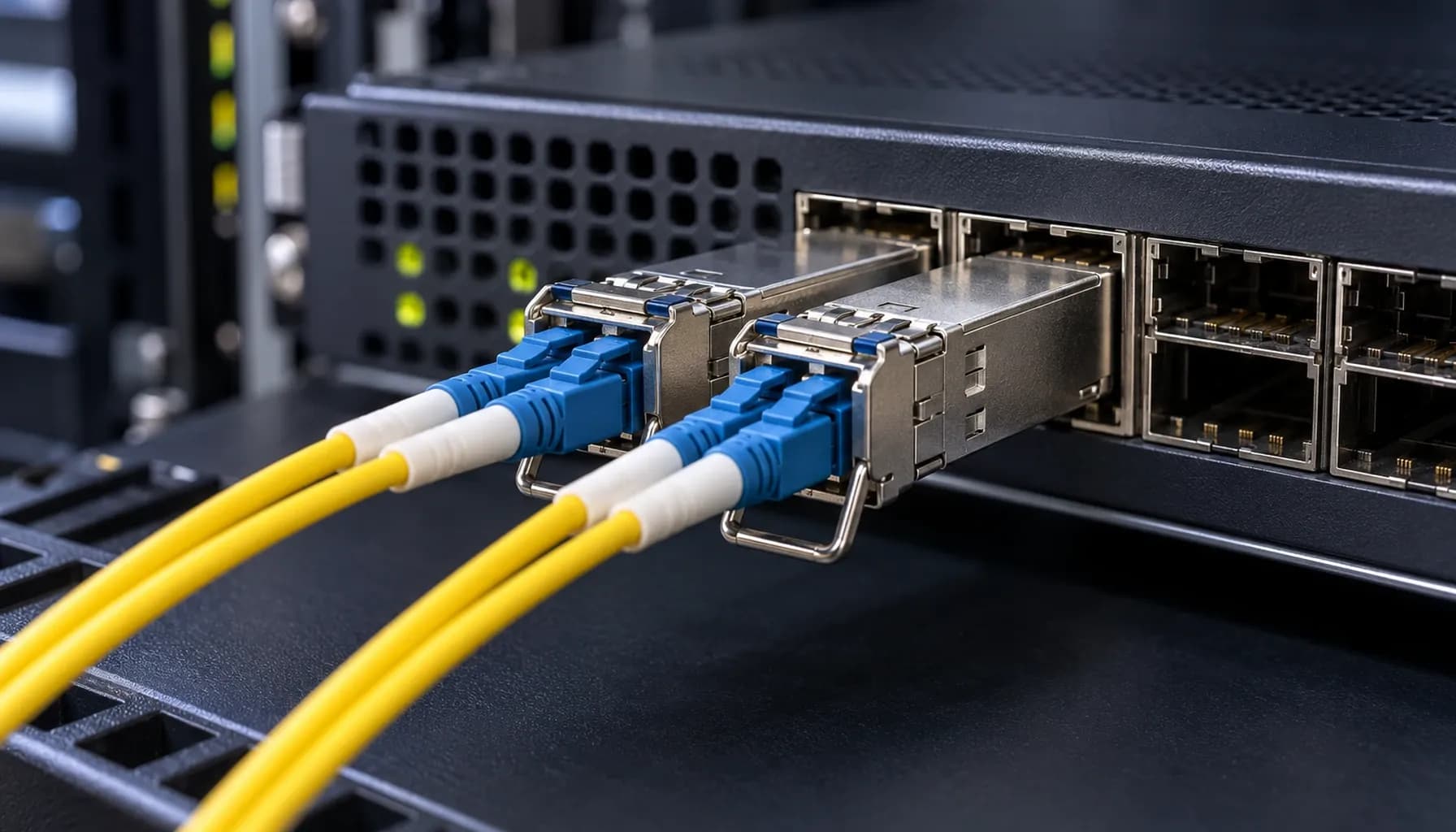
Utility-grade solar telemetry starts where Ethernet cannot: the three phase bi-directional energy meter RS485 Modbus port. It records imported grid and exported PV energy; an isolated RS485-to-Ethernet gateway converts Modbus RTU to Modbus TCP or a SCADA protocol. Only the gateway connects to Ethernet. Cisco Catalyst, Nexus, Arista 7050X, and Juniper QFX cannot read RS485 without a transceiver.
Standards: Separate the Use Case from the Wiring
IEC 62053-21 and 62053-22 are often described as direct-connected versus transformer-operated standards. That is unsafe shorthand. IEC 62053-21 covers static meters for residential and similar use, commonly Class 0.2 S. IEC 62053-22 covers acceptance testing and contract settlement, commonly Class 0.1 S or 0.2 S. Topology alone does not determine the approved class.
The certified configuration, utility-approved equipment list, and contractual class must agree. Transformer-operated meters often use 62053-22, but verify the architecture rather than infer it from the standard number.
| Design dimension | Direct-connected metering | Transformer-operated metering |
|---|---|---|
| Physical path | Current terminals connect directly to the metered incomer. | CT/VT scale the primary to 1 A/5 A secondary. |
| Typical IEC route | 62053-21, usually Class 0.2 S for the approved configuration. | 62053-22, usually Class 0.1 S or 0.2 S for settlement. |
| Accuracy boundary | Error is measured at meter terminals. | Meter plus CT/VT ratio, phase, composite, and burden errors. |
| Main installation risks | Contacts, busbars, overload, wiring, and meter burden. | CT saturation, ratio/polarity, VT error, cable drop, and phase error. |
| Range and burden | Product range; verify reverse-start threshold. | 1 A/5 A secondary; check CT range, knee point, and aggregate burden. |
| Bidirectional evidence | Prove import/export energy and reverse start. | Add transformation ratio, phase sequence, and reference comparison. |
| SCADA endpoint | Usually RS485 Modbus RTU via an isolated gateway. | Same, but expose transformer-corrected values and status flags. |
The “S” designation identifies a tested class over specified current, voltage, power-factor, temperature, and start-current conditions. A Class 0.1 S meter with Class 0.2 S CTs is not an installed Class 0.1 S chain. Specify CT ratio, accuracy, phase displacement, composite error, knee point or safety factor, and meter/cable burden.
For Dubai, align the exact meter, CT/VT, and telemetry design with the DEWA Shams Dubai Solar Net Metering: DRRG Compliance & Smart Metering: The Complete UAE Engineering Guide (2026); IEC compliance remains only one approval layer.
Key takeaway: The IEC part follows the metering use case; the utility-approved certificate and installed error budget determine the final class.
RS485 Fieldbus Design
Physical Layer
Use a shielded twisted-pair trunk, not a star. Daisy-chain meters, keep stubs short, terminate approximately 120 Ω only at the two physical ends, and provide fail-safe bias once. A/B and D+/D− labels vary between manufacturers, so follow each device manual.
Use galvanic isolation and surge protection, bond shields according to the site EMC plan, and separate the bus from PV DC, high-current AC, and contactor coils. Select baud rate from measured length and noise; 1200/2400 baud is safer than 9600/19200 on marginal long runs.
Register and Polling Contract
Modbus is transport, not a data dictionary. Freeze vendor addresses, signedness, scaling, decimals, rollover behaviour, word/byte order, and update latency. A 32-bit energy value may use either word order; an unsigned counter may wrap, while a signed quantity can represent reverse flow.
Poll import, export, per-phase values, status, and alarms only at supported rates. Use fixed timeouts, bounded retries, invalid partial reads, and SCADA-defined unit conversion. Preserve raw engineering values inside the gateway to prevent cumulative rounding across polling cycles.
Key takeaway: RS485 electrical stability and register semantics are separate acceptance tests; a healthy link can still deliver commercially incorrect energy data.
Ethernet Handoff and Switch Interoperability
Architect meter → isolated RS485 gateway → access port → OT VLAN → SCADA collector. A Catalyst 9300 can provide cabinet access and a Nexus 9300 aggregation; an Arista 7050X or Juniper QFX can provide equivalent aggregation. RS485 ends at the gateway, so switch commands cannot set baud, parity, termination, or slave address.
Multi-Vendor Access-Port Configuration
The following commands illustrate equivalent policy on Cisco IOS XE, NX-OS, Arista EOS, and Juniper QFX. Adapt interface names and VLAN numbering to the actual design.
1! Cisco IOS XE / Catalyst 93002interface GigabitEthernet1/0/103 description Solar SCADA RS485 gateway4 switchport mode access5 switchport access vlan 4206 spanning-tree portfast7 spanning-tree bpduguard enable8 no shutdown9
10! Cisco NX-OS / Nexus 930011interface Ethernet1/1012 description Solar SCADA RS485 gateway13 switchport mode access14 switchport access vlan 42015 spanning-tree port type edge16 spanning-tree bpduguard enable17 no shutdown18
19! Arista EOS / 7050X20interface Ethernet1021 description Solar SCADA RS485 gateway22 switchport access vlan 42023 spanning-tree portfast24 spanning-tree bpduguard enable25 no shutdown26
27! Juniper QFX - replace xe-0/0/10 with the platform-supported interface28set interfaces xe-0/0/10 description "Solar SCADA RS485 gateway"29set interfaces xe-0/0/10 unit 0 family ethernet-switching interface-mode access30set interfaces xe-0/0/10 unit 0 family ethernet-switching vlan members 420
VLAN 420 is illustrative, not a utility mandate. Use an access VLAN, edge/BPDU protection, and collector-only ACLs. Modbus has no native authentication or encryption; isolate it from the internet and use authenticated management plus VPN for remote paths.
For hot cabinets, apply the Choosing a Temperature Grade for Gulf Deployments: C-Temp, E-Temp and I-Temp Compared for 100G (2026) guidance. For installed 100G modules, check the End-of-Sale Countdown for 100G Modules: Last Ship Date, Routine Failure Analysis and Support Windows (2026) before freezing the uplink bill of materials. Prefer gateways with buffered logs, watchdogs, and redundant power.
Key takeaway: The switch terminates Ethernet; an isolated gateway terminates RS485 and owns serial timing, addressing, and diagnostics.
Commissioning as a Network Test
Test import and export against a calibrated reference at low load, rated load, low power factor, and voltage extremes. For transformer metering, prove CT ratio, polarity, phase sequence, displacement, and non-saturation.
Power-cycle the gateway and open the RS485 pair; SCADA must alarm, preserve context, and recover without duplicate registers. Archive serial settings, firmware, topology, polling, register map, results, and time configuration.
Key takeaway: Reverse-flow acceptance is incomplete until meter accuracy, SCADA registers, and fault recovery pass together.
Frequently Asked Questions
Is IEC 62053-21 only for direct-connected meters?
No. The split is use case and accuracy, not wiring topology. IEC 62053-21 covers static meters for residential and similar use, commonly Class 0.2 S; IEC 62053-22 covers acceptance testing and settlement, commonly Class 0.1 S or 0.2 S. Either family may include direct-connected or transformer-fed products, so verify the exact type approval and utility specification.
What accuracy class should a UAE solar installation specify?
Use the utility’s approved meter schedule, then verify the IEC part, class, current range, temperature range, and bidirectional certification for the exact model. Transformer-operated settlement normally requires Class 0.1 S or an expressly accepted 0.2 S design. Installed accuracy also includes CT/VT ratio, phase error, burden, wiring, and power factor. IEC compliance does not replace utility approval.
Can one three-phase bidirectional meter feed Solar SCADA over Modbus?
Yes, if the meter exposes bidirectional active-energy registers through RS485 Modbus RTU. The gateway polls them and exposes Modbus TCP or the SCADA protocol. Verify import/export identifiers, signedness, scaling, word and byte order, rollover, and update latency in the vendor map. Test both directions; reverse energy must not be inferred locally from total energy because losses and tariff logic differ.
Do Catalyst, Nexus, Arista 7050X, and Juniper QFX ports support RS485?
No. These switches expose Ethernet, not RS485. Use an industrial RS485-to-Ethernet gateway with galvanic isolation, surge protection, configurable Modbus RTU timing, and buffered logging. Connect it to an access port; the switch provides VLAN segmentation and reachability only. Verify gateway watchdogs and polarity because A/B labels vary between vendors.
How should CT ratios and metering accuracy be verified?
Verify CT ratio, accuracy class, phase-displacement error, composite error, burden VA, knee-point/safety factor, and excitation current against the design. Confirm the 1 A or 5 A secondary does not saturate at maximum load, and meter plus cable burden remains within the CT limit. Test low load, rated load, and reverse power against a reference instrument, recording ratios and utilities.
Key Takeaways
- Approve the exact meter, CT/VT, gateway, and register map against the utility schedule.
- Budget transformer error and burden at maximum load, then verify the installed chain.
- Standardize RS485 topology, termination, isolation, addressing, and register semantics.
- Isolate gateways in an OT VLAN and apply equivalent access-port controls across all switch platforms.
- Witness bidirectional, reverse-start, gateway-restart, and communications-loss tests before handover.
Conclusion
Direct-connected and transformer-operated designs fail for different reasons: fieldbus behaviour and measurement error. Specify the approved class, prove the installed chain, and validate reverse flow under SCADA faults. For a lifecycle-checked bill of materials covering metering, gateways, switches, optics, and support, request a quote through the Strinex catalogue.