
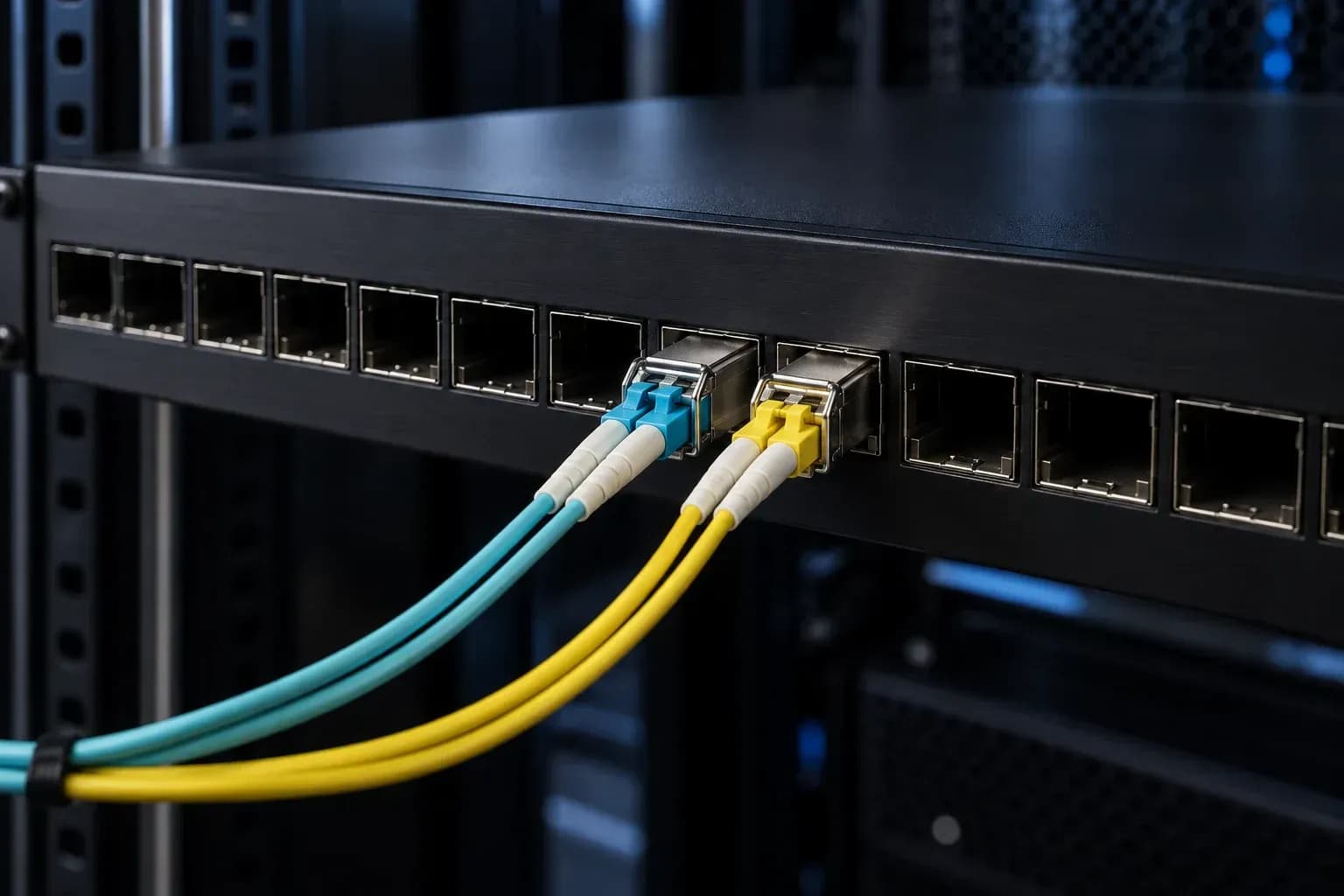
For a 10GBASE-SR versus 10GBASE-LR decision, start with the cable plant you already own. An SR optic belongs on a qualifying OM3 or OM4 multimode channel. LR belongs on OS2/G.652 single-mode fibre. A longer number on a data sheet does not make LR the safer choice for a short link in a Dubai Internet City data centre, and it does not rescue an unverified fibre route.
Document the route, module pair, connector and splice count, polarity, switch port capability and channel loss before the maintenance window. That short pre-check prevents most expensive transceiver swaps.
SR and LR are different optical systems
10GBASE-SR normally uses an 850 nm VCSEL over multimode fibre. 10GBASE-LR normally uses a 1310 nm DFB laser over single-mode fibre. Cisco reference limits put SR at 300 m on OM3 and 400 m on OM4, while the LR class is commonly specified to 10 km on G.652 fibre. Those values describe a compliant channel under stated conditions. They do not validate an installed path or every commercial module carrying an LR label.
The Alpha Bridge ASFP-10G-SR 10G SFP+ optical transceiver is specified for 10 Gb/s, 850 nm, LC duplex, OM3/OM4 multimode fibre, and runs up to 300 m. It is a good fit for a qualifying short multimode channel. It is not an OS2 solution.
Calculate the link budget before ordering. Available budget equals minimum transmitter output minus receiver sensitivity. Compare it with measured fibre attenuation, connector loss, splice loss, and an engineering margin. Keep 3 dB in reserve where the channel allows it. In a high-density line card environment, that margin matters more than a generous brochure reach.
| Decision input | SR route | LR route |
|---|---|---|
| Installed medium | Qualifying OM3/OM4 multimode | Qualifying OS2/G.652 single-mode |
| Optical class | 850 nm VCSEL | 1310 nm DFB |
| Usual deployment | Rack, row, or short data-centre link | Campus or inter-building link |
| Evidence required | Length, loss, polarity, and endpoint data sheets | Exact LR data sheet, length, loss, and endpoint data sheets |
Key takeaway: Fibre type, measured loss, and the endpoint specifications select the optic. Headline reach only sets the outer boundary.
Compare the part number, not the category name
A vendor label does not prove interoperability, coding, availability, or warranty coverage. Treat every third-party or refurbished optic as a specific part-number decision. That is especially true when a site mixes Cisco, Juniper, Arista, and MikroTik hardware.
| Parameter | Strinex Alpha Bridge | FS.com equivalent | Cisco OEM | Generic or refurbished |
|---|---|---|---|---|
| Data rate | 10 Gb/s SFP+ | Confirm selected SKU | Confirm selected SKU | Verify label and data sheet |
| Wavelength and fibre | 850 nm, LC duplex, OM3/OM4 MMF | Confirm SR or LR SKU | Match qualified optic to circuit | Verify wavelength, fibre, and connector |
| Maximum reach | Up to 300 m for ASFP-10G-SR | Depends on SKU and fibre | Depends on SKU and fibre | Verify exact part number and condition |
| DDM/DOM | Specified; SFF-8472 basis | Confirm selected SKU | Depends on SKU and platform | Validate before production use |
| Switch acceptance | Validate host, software, and port | Coding and host validation required | Qualified platform combinations | Highest validation burden |
| UAE delivery and warranty | Check live Dubai dispatch and product terms | Confirm at order | Confirm at order | Confirm provenance, lead time, and terms |
Use the Alpha Bridge ASFP-10G-SR 10G SFP+ optical transceiver only inside its stated 300 m multimode specification. For LR, get the exact data sheet for the part number under consideration. “10 km LR” is a class reference, not a blanket promise.
Interoperability still needs a host check
SFF-8431 defines the SFP+ electrical and mechanical interface. SFF-8472 defines diagnostic telemetry: temperature, supply voltage, transmit bias, transmit power, and receive power. Those standards provide a common baseline; they do not force a host to accept every EEPROM coding or extend OEM support to a non-OEM optic.
Check the exact 10G port before insertion. Catalyst and Nexus estates need model- and release-specific confirmation. Juniper EX and QFX deployments should be checked in the Hardware Compatibility Tool for the target Junos release. Arista 7050SX installations need the applicable Transceiver and Cable Guide plus the installed EOS version. On MikroTik RouterOS, check cage speed, EEPROM visibility, link state, and diagnostics on the actual release in use.
At turn-up, verify matching optical classes, LC-duplex polarity, speed, interface errors, and DOM values. Record a stable-link baseline first. An Rx-power reading only means something when you compare it with that module's thresholds and the same port's normal behaviour. For host-specific considerations, read SFP+ transceiver compatibility on Cisco, Juniper and Arista.
Field work: inspect before replacing optics
Start with the physical route. Read the cable jacket marking, trace the length, count panels and mated pairs, identify splices, verify A-to-B polarity, and confirm the port form factor. This catches the familiar failures: SR plugged into OS2, a 1G cage mistaken for 10G, or a polarity error masked as an “optic problem.”
Keep bend radius above 30 mm. For LC connections, use an IEC 61300-3-35-aligned sequence: inspect ferrules and adapters, dry-clean with a one-click cleaner, inspect again, then connect. Dust is mundane, but it regularly consumes more outage time than the module itself.
Use a power meter to compare received power against the module limits. Use a visual fault locator to find gross breaks or routing mistakes. Neither replaces a measured end-to-end loss result. Acceptance requires the measured path loss to reconcile with the budget calculated from the two endpoint data sheets.
Tools that isolate the fault
Connector inspection, channel-loss testing, and fault location answer different questions. Run them in that order. It stops teams from swapping a healthy SFP+ because an unclean connector is driving the alert.
- Fluke Networks FI-7000 FiberInspector Pro inspects connector end faces for contamination and scratches.
- Fluke Networks CertiFiber Pro OLTS measures optical loss and produces a channel acceptance record.
- Fluke Networks VisiFault Visual Fault Locator locates major continuity breaks, poor connections, and routing errors on accessible paths.
Frequently asked questions
What is the distance difference between 10GBASE-SR and 10GBASE-LR?
Reference limits are 300 m on OM3 and 400 m on OM4 for SR, versus 10 km on G.652 single-mode fibre for LR. They are maximums under specified conditions, not installed-channel guarantees. Confirm the exact module data sheet and measured loss.
Can I use a 10GBASE-SR SFP+ on OS2 single-mode fibre?
No. SR is an 850 nm multimode optical class, not an OS2 solution. Use a matched single-mode design, such as LR, with compatible fibre, wavelength, and endpoints.
Is 10GBASE-LR better than SR?
No. LR solves a longer single-mode requirement; SR is right for a qualifying short OM3/OM4 channel. Buying LR for the larger reach figure can create the wrong channel design.
How do I calculate an SFP+ fibre loss budget?
Subtract receiver sensitivity from minimum transmitter output to find the available budget. Total fibre loss, connector loss, splice loss, and the documented engineering margin using the exact endpoint data sheets. Retain 3 dB of margin where possible.
What does SFP+ DOM/DDM show?
SFF-8472 diagnostics report temperature, supply voltage, transmit bias, transmit power, and receive power. Use the readings as telemetry, compare them with module thresholds, and retain a stable-link baseline.
Selection checklist for UAE network teams
- Select SR for a qualifying short OM3/OM4 link and LR for a qualifying OS2/G.652 link. Distance alone is not the decision.
- Calculate the optical budget from endpoint data sheets and measured path loss; hold 3 dB of margin where the route permits it.
- Treat MSA conformance as an interface baseline, not a guarantee of host acceptance or OEM support.
- Inspect and clean LC connections before replacing transceivers or escalating a power alarm.
Buy against the measured channel
The SR versus LR decision is cable-first. Qualify OM3/OM4 for SR or OS2/G.652 for LR, prove the path with a loss budget, then validate the exact module pair on the target switch software. For a short multimode route, the Alpha Bridge ASFP-10G-SR 10G SFP+ optical transceiver is a verified 850 nm, LC-duplex, 300 m option. Check current Dubai dispatch and product terms, then send Strinex the switch model and release, fibre marking, route length, measured loss, and quantity before purchase.